
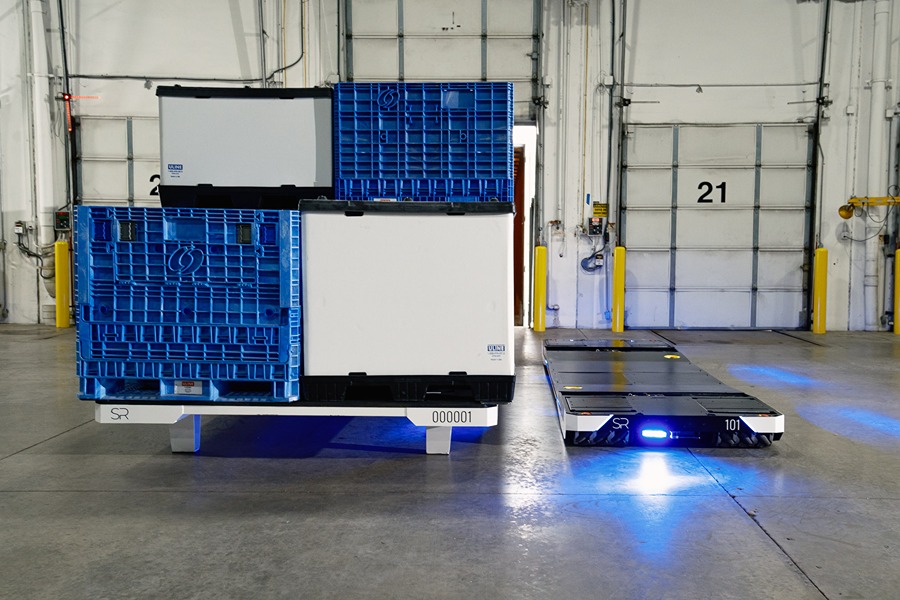
Slip Robotics announced SlipLift, a new platform designed to extend autonomous trailer loading and unloading beyond short-haul, high-frequency routes to heavier freight, regional distribution, and last mile delivery applications. SlipLift brings Slip’s hallmark speed, safety, and simplicity to a broader set of dock operations without requiring changes to facilities, trailers, or IT infrastructure.
SlipLift is a core architectural shift that decouples the robot from the payload. This approach delivers SlipBot-level speed, safety, and labor savings while allowing fewer robots to cover more docks, resulting in faster and more predictable dock operations.
Slip Robotics introduced SlipBot to solve short-haul, high-frequency, closed-loop loading. In those environments, SlipBot enables trailers to be loaded and unloaded in five minutes, delivering fast, highly consistent dock turns that make operations predictable. SlipLift builds directly on that foundation, extending Slip’s robots-as-a-service model to routes and applications where payload weight, route length, or dock variability previously limited automation.
As Slip worked with customers across manufacturing, distribution, and logistics, a clear pattern emerged.
Heavy short-haul, high-velocity operations such as food and beverage, packaging and paper products, and dense automotive assemblies benefit from SlipLift’s support for payloads up to 20,000 pounds, enabling automation for heavier freight while maintaining fast, consistent dock turns.
Regional and medium-haul distribution networks, including consumer packaged goods, cold chain hubs, and furniture distribution, can use fewer robots to service more doors. Decoupling robots from individual shipments allows automation to scale across multi-site networks without requiring a robot at every door.
Last-mile delivery operations benefit from SlipLift’s ability to pre-stage freight ahead of daily routes. Morning load-outs can be completed in minutes, enabling more deliveries per day while reducing driver dwell time and congestion at the dock.
SlipLift operates through a simple, repeatable workflow. A SlipLift picks up a loaded SlipCarrier from the dock, autonomously places it inside a trailer or box truck, and exits before repeating the process until the load is complete. Operators remain outside the trailer using a handheld controller, while the robot handles navigation, alignment, and placement.
SlipCarriersare a key enabler of this flexibility. Instead of modifying robots to handle new freight types, SlipCarrierscan be customized to support different payloads, simplifying configuration and expansion. When empty, SlipCarriersstack up, saving dock space and enabling efficient transport.
SlipLift will be showcased publicly at Manifest 2026, followed by MODEX 2026, with initial deployments underway and broader availability planned throughout the year.
Originally written by: Srabanti Chakraborty
Source: engineering.com
Published on: 4 February 2026
Link to original article: Slip Robotics introduces SlipLift for autonomous trailer loading
