
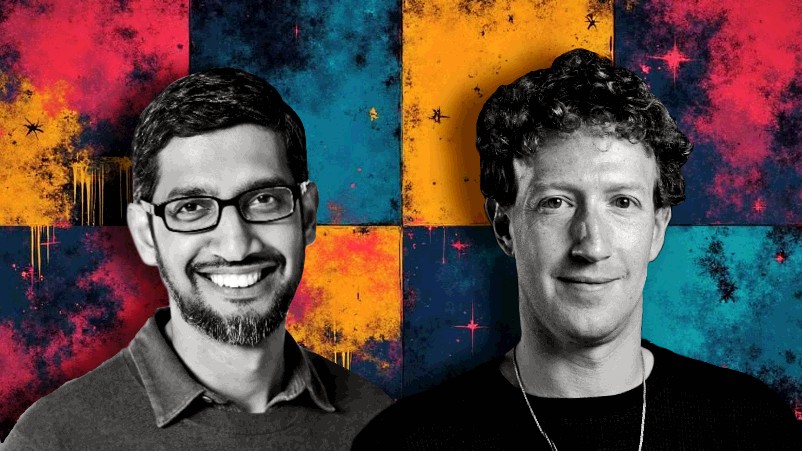
The world’s two biggest advertising machines have stopped talking about AI as a promise and started counting it as profit. Google and Meta’s latest earnings show artificial intelligence now sits at the core of ad creative, targeting, measurement and media economics, reshaping where attention lives, how fast campaigns move and who captures value. For CMOs, the message is blunt: the platforms are sprinting ahead, video is eating television, and the cost of not adapting to AI-led marketing just went up. And that $320bn price tag- guess who ultimately pays?
What you need to know
- Google and Meta combined for over US$600 billion in annual revenue, with advertising accounting for the vast majority.
- Google’s AI Max drove a 23 per cent revenue increase for L’Oréal’s NYX and 80 per cent conversion uplift for Aritzia.
- Meta doubled GPU power for ad-ranking models in Q4, delivering 3.5 per cent higher Facebook click-throughs.
- YouTube Shorts now out-earns traditional in-stream video per watch hour in the US.
- Google Cloud grew 48 per cent YoY with generative AI products up nearly 400 per cent.
- Combined capex guidance of $320 billion exceeds New Zealand’s GDP.
- YouTube hit $60 billion in combined ads and subscriptions – podcast viewing up 75 per cent YoY.
- Meta’s AI video generation tools reached $10 billion annual revenue run rate.
- Both companies remain “capacity-constrained” despite massive infrastructure investment.
- Google signed more billion-dollar cloud deals in 2025 than the previous three years combined,
AI Max enabled L’Oreal to maximise its presence across the full consumer journey, fuel its consumer growth, and increase revenue for direct to consumer brands like NYX by 23 per cent. Aritzia, Canada’s premier fashion house, used AI Max to find new high-value customers that traditional strategies miss, delivering an 80 per cent incremental uplift in conversion value for Q4.
— Google Chief business officer Philip Schindler
This past week has delivered a stark reminder of where the world’s river of advertising dollars is flowing and what’s driving the current.
Alphabet reported annual revenue surpassing US$400 billion for the first time, while Meta passed $200 billion – with AI driving ad creative, targeting and measurement.
The titans both revealed a roadmap for marketers about where consumer attention lives in 2026 and how AI is already altering the economics of digital advertising.
At Google, search still rules with revenue climbing 17 per cent year-over-year to US$63 billion in the quarter. CEO Sundar Pichai told investors the moment was “expansionary” with answer engines AI Overviews and AI Mode both hitting record usage levels. Retail, finance, and healthcare advertisers were among the verticals leaning in most heavily with budgets, he said.
Meta’s 24 per cent – reported last week – outpaced Google powered by its aggressive deployment of AI across its ad stack. CFO Susan Li said AI integrations into ad targeting combined with content recommendations had led to Facebook click-throughs rising 3.5 per cent and Instagram conversions up one per cent.
Meta also announced it doubled computing power to train and optimise its ad-ranking models in the past quarter.
The results show the world’s two largest ad platforms are increasing their share of the overall market. Google’s ads business generated US$82 billion in the fourth quarter, mainly across search and YouTube. At Meta, advertising revenue is now 97 per cent of its total earnings, at $58 billion in the past quarter.
AI ads have arrived
Both companies used their earnings reports to position AI not as a future opportunity but the current engine of performance.
Google said its deployment of Gemini across its ad quality stack was improving query understanding and better monetisation of longer and more complex searches. Its chief business officer Philip Schindler said Gemini’s improvements were allowing them to deliver ads on queries that were “previously challenging to monetise”.
Google’s AI Max product was now being used by hundreds of thousands of advertisers, and unlocking billions of new queries.
Per Schindler: “L’Oreal used AI Max across 800 unique campaigns in 23 countries and 30 brands. AI Max enabled L’Oreal to maximise its presence across the full consumer journey, fuel its consumer growth, and increase revenue for direct to consumer brands like NYX by 23 per cent.
“Aritzia, Canada’s premier fashion house, used AI Max to find new high-value customers that traditional strategies miss, delivering an 80 per cent incremental uplift in conversion value for Q4.”
Meta said video generation tools built on the company’s AI infrastructure reached a $10 billion combined revenue run rate in the fourth quarter.
With AI handling creative generation, audience matching, and bid optimisation, both claim they are optimising marketing outcomes at unprecedented scale.
Video’s attention economy
YouTube was a standout. Its 2025 revenue hit $60 billion across advertising and subscriptions, marking a milestone in its evolution into a dominant streaming service.
According to Nielsen data, YouTube has been the number one streaming platform in the US for nearly three years running. The living room has become its stronghold. In October 2025, viewers watched more than 700 million hours of podcasts on living room devices, a 75 per cent increase from the year before.
The platform is also deepening its grip on live sports. NFL Sunday Ticket subscriber growth was strong, and the company announced plans to launch new YouTube TV packages with 10 genre-specific tiers to give subscribers more flexibility.
Shorts, YouTube’s short-form video product, now averages 200 billion daily views – with Google revealing it makes more per watch hour than traditional in-stream video in the US and several other markets.
YouTube advertising revenue grew nine per cent year-on-year to $11.4 billion in the quarter, though the company noted results were dragged by lapping strong US election spending from Q4 2024.
On the creator side, AI tools are gaining rapid adoption. In December alone, more than one million channels used Google’s new AI creation tools daily. And more than 20 million viewers used a new Ask feature powered by Gemini to learn more about the content they were watching.
Meta’s Mark Zuckerberg used his earnings call to position AI-generated video and content as the next evolution in media formats. He predicted an “explosion of new media formats that are more immersive and interactive”.
The company’s experimental Vibes feed in the Meta AI app, which surfaces AI-generated short videos, represents an early implementation of this vision, he said.
The comments are a signal the titans are setting out their strategic positions.
YouTube’s focus is on its strength in long-form content, podcasts, and live events, targeting traditional television and streaming services, in the lounge room, while Shorts competes directly with TikTok and Instagram Reels.
Meta’s 3.58 billion users across its family of apps provide unmatched distribution for video content, while its AI investments suggest a future where content creation itself becomes increasingly automated.
Infrastructure muscle
Both companies announced eye-watering expenditure guidance to stay ahead in the AI race. Google told investors to gird up for a doubling of spending to US$185 billion. Meta’s also nearly doubling to US$135 billion – together, that’s the GDP of New Zealand. Alphabet CFO, Anant Ashkenazi said 60 per cent was going to servers and the rest to giant data centres to host them all.
The flywheel of investing in compute to sell to customers is the driving force behind Google’s flourishing cloud division. It soared 48 per cent over the past quarter putting it on a US$70 billion revenue run rate for the year ahead.
Pichai said: “We’re winning more new customers faster. We’re also signing larger commitments. Deals over $1 billion surpassed the past three years combined.”
Ashkenazi added: “In Q4, revenue from products built on our generative AI models grew nearly 400 per cent year-over-year.”
Among the notable new partnerships is Apple. Pichai confirmed a collaboration for Gemini to power Apple Intelligence and the next generation of Siri.
Meta CFO Li added that despite the spending, demand was so high it remained “capacity-constrained” for the year ahead as additional capacity comes online.
For marketers, Google and Meta are in an infrastructure buildout phase to improve ad targeting, faster creative iteration, and more sophisticated measurement. It also signals that the competitive moat around these platforms continues to deepen.
Subs growth
Despite wins in ads, both revealed they are building meaningful subscription businesses. Google reported 325 million paid subs led by Google One and YouTube Premium, with strong growth in YouTube Music over the quarter. Meta revealed WhatsApp paid messaging reached a $2 billion annual run rate, while Zuckerberg indicated that Meta AI will soon support subs and ad revenue models.
Both see subscription growth as a diversification bet against ad market fluctuations, while building deeper user relationships that inform advertising targeting.
Regulatory clouds
And despite the bullish earnings, Google faces unresolved legal threats on multiple fronts.
A federal judge is expected to rule in the coming weeks on remedies in its ad tech antitrust case. A US judge has already ruled Google illegally monopolised parts of the ad stack and is weighing whether to force Google to sell off parts of it. The Department of Justice also announced this week it will appeal for harsher penalties after Google lost the search antitrust case.
Regulators are also circling overseas. UK authorities last week proposed allowing publishers to opt out of Google’s AI Overviews.
None of the analysts on the earnings call raised this, but Brian Wieser, principal analyst at Madison and Wall, told The New York Times: “There will be changes to how Google operates and places where they have to bend a little bit.
“But on the advertising side, it’s hard to see anything that will cause them to lose revenues because their scale is unmatched.”
Implications for marketers
First, it’s notable that both Google and Meta are advancing AI-powered ad capabilities faster than most customers can adapt, indicating they are banking on a long-term return.
Second, they are locked in an arms race to use AI to gain a proprietary data advantage.
Third, significant disruption is ahead of the marketing industry as Gemini and Meta’s models generate insights and creative assets at a scale and speed impossible for humans.
Fourth, the video attention economy continues to fragment across formats and surfaces.
YouTube is coming after TV budgets like never before, now it has unrivalled dominance as the leading living room streamer.
Meta revealed its video generation tools reached a $10 billion annual revenue run rate in Q4.
Originally written by: Ricky Sutton
Source: Mi3
Published on: 9 February 2026
Link to original article: AI advertising era arrives but with a huge price tag, Alphabet and Meta place US$320bn bet on infrastructure, video and automation; Regulators circle, marketers struggle to keep pace
