
As Arizona State Unviversity continues to shine in U.S. patent rankings, robotics and artificial intelligence garner a growing percentage of such technologies.
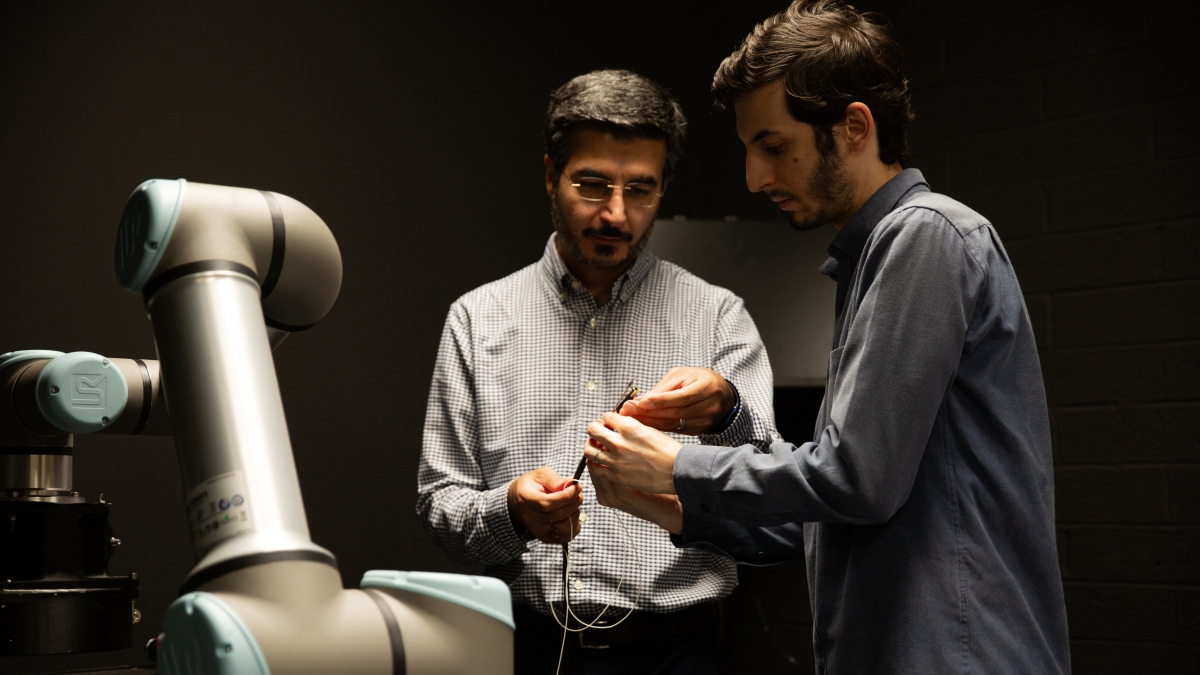
Two faculty members among the leaders in patent acquisition are “YZ” Yezhou Yang, an associate professor in Arizona State University’s School of Computing and Augmented Intelligence, and Hamid Marvi, an associate professor in the School for Engineering of Matter, Transport and Energy. Their work is centered on the increasing intersection of AI and robotics.
“Robots don’t have to look like robots,” Yang said. “A robot is a combination of intelligent, AI decision-making together with novel mechanical design — and it doesn’t have to look humanoid. My research serves as the brain and eyes driving many robotic devices. Hamid’s research couples that with their muscles and physical presence.”
Key insights for traffic safety, identifying ‘fake’ images
Yang’s Active Perception Group lab explores visual perception — a field of AI that analyzes images and videos to recognize objects, understand the relationships between those objects and the environment, and learn how to make decisions based on that input. Applications include developing safety tools for autonomous technologies and medical assist technologies, creating AI-generated images and recognizing AI-generated, or fake, images.
One of Yang’s current projects, in partnership with the Maricopa County Department of Transportation and the Arizona Commerce Authority’s Institute of Advanced Mobility (IAM), is developing an intelligent traffic monitoring system that sends notifications about pending accidents. He serves as the lead technologist on IAM’s Automated Traffic Incident, Reconstruction, Indexing and Reporting project.

Using his patented Car-On-Map (CAROM) framework and sensing systems like lidar, satellite image mapping and intersection video, the system can identify potential accidents in advance and send warnings to vehicles, pedestrian and driver cellphones in the area, as well as law enforcement and emergency response organizations.
“Vehicles are progressing toward being more intelligent and connected to the internet. Ultimately, any vehicle, whether fully autonomous or not, will be able to receive these alerts.” Yang said.
A pilot program is being implemented at a busy intersection in the Phoenix metro area.
“At the moment, I believe that intersection is the most well-equipped with safety tools in the nation,” Yang said. “It’s using many advanced technologies with a goal of developing an alert communication system that can prevent accidents.
Another of Yang’s projects involves the identification of “fake” images.
“There are all kinds of images that are AI-generated,” Yang said. “We have come up with a system to determine which images are real photos and which have been generated or modified using AI.”
The system examines an image “pixel by pixel” to identify anomalies and determine if it has been wholly invented or partially doctored.
“In some cases, we may even be able to determine the user ID of who created the image,” Yang said.
He anticipates the technology will be of great value to media outlets, enabling them to verify whether images are real or fake.
“If consumers know that images have been authenticated, it will support the trustworthiness of participating media.”
Minimizing the need for invasive surgery
One arena of Marvi’s research at the Bio-Inspired Robotics Technology and Healthcare (BIRTH) lab is minimally invasive medical robotics, which has accelerated its reliance on AI for treatment deliveries, including advanced endoscopic systems and magnetic steering devices.
In collaboration with a national, medical-academic research center, Marvi and his team are developing a robotic endoscopic surgery platform to treat colorectal cancer, providing endoscopists with a robotic “second hand” to assist in performing endoscopic submucosal dissection.
“Currently, endoscopists rely on a single instrument — the endoscope — to visualize the tumor and manipulate the tissue that needs to be removed, and perform the removal,” he said. “They work beneath the tissue with limited visibility and no ability to actively pull the tissue back. Just a few millimeters below lies the muscle layer that, if damaged, can lead to serious adverse side effects.”
Marvi’s project involves deploying a magnetic clip endoscopically and, once in place, using a magnet outside the body, operated by a robotic arm, to manipulate the tissue and facilitate the tumor removal process.

“Now the endoscopist has an additional hand,” Marvi said. “The robotic arm manipulates the tissue, pulling it back, while the endoscopist is controlling the scope to view and remove the tumor. It is a much easier and safer process, and the procedure time is reduced by up to 50% in preclinical experiments.”
Although there is a joystick component to the robotic arm, it can be directed by voice command from the surgeon.
“Endoscopists need both hands to operate the scope,” Marvi said.
Not much time is needed to learn to operate the robotic arm, according to Marvi: “Even clinicians in training can quickly begin performing the procedure.”
The next stage, for which Marvi has a pending proposal in collaboration with ASU Assistant Professor Wanxin Jin, is making the robotic arm autonomous, Marvi said.
“The robot learns to adapt to the procedure autonomously and manipulates the tissue. As the endoscopist is cutting, the robotic system gently pulls back the tissue so the tumor can easily be removed. The robot will automatically detect if the endoscopist changes cutting direction and adapt,” Marvi said.
The trials are preclinical and managed by the collaborating center’s approval team, so progress is moving fairly swiftly.
The team is completing the final version of the autonomous robotic arm before moving toward clinical trials and formal Food and Drug Administration review. They aim is to finish development within the next year, begin preclinical testing in early 2027 and take the next steps toward FDA approval soon after.
Another breakthrough project Marvi’s team is developing — a less invasive technology for neurosurgical procedures — is in collaboration with Barrow Neurological Institute.
“Currently, doctors can only deliver electrodes, catheters or medications to the brain along straight paths. As a result, reaching multiple target areas often requires multiple separate and invasive entry points into the brain tissue,” Marvi said.
Additionally, fluoroscopy, a continuous X-ray beam, is used for placement and monitoring of implants, delivering exposure to both patient and surgeon.
“Our project adds shape sensors inside the implant, which will enable us to do real-time, 3D sensing with no radiation,” Marvi said. “We are doing a combination of mechanical feeding with magnetic steering inside the brain tissue to enable nonlinear implant steering.”
An adjacent project with Barrow is endovascular robotic surgery, focused on removing blood clots from the brain, a procedure known as thrombectomy.
“When there is a stoke, there usually is a blood clot in the vascular system of the brain,” Marvi said. “They need to remove the clot and re-vascularize, getting the blood flow back as soon as possible. Every minute counts.
“We are proposing a fully autonomous, robotic system that requires a technician to introduce the electrode to the appropriate femoral entry point and let the robotic system take over. It would steer to the clot, remove it and return to the entry point, where the technician can remove it from the body.”
According to Marvi, there are about 300 centers and about 1,100 surgeons across the U.S. capable of doing a thrombectomy. As a result, only 10% of stroke victims get appropriate treatment, which comes with side effects and a heavy burden on a health care system that has a shortage of surgeons, especially in rural areas.
“This autonomous system is an example of how a stroke victim can go to a rural hospital, have a minimally invasive procedure, then go home and have an ice cream instead of spending days in the hospital, months of physical therapy and dealing with the aftereffects of the current stroke treatments,” Marvi said.
“I’ve been observing surgeries related by my research. It’s a life-changing experience to see how difficult, time-consuming and invasive some current procedures are.
“When I contemplate the possibilities of how we can make the process faster, easier, safer and less invasive, at a significantly reduced cost on the health care system, it’s mind-blowing. It’s what’s motivates me to pursue this path.”
For Marvi and Yang, as with most academic innovators, the rewards come from creating technologies that improve lives.
Supporting their ASU inventors’ success is Skysong Innovations, which works with ASU faculty members and partner institutions to convert scientific research into patented technologies that can be rapidly transferred into the marketplace. ASU secured 185 U.S. utility patents in calendar year 2025.
Originally written by: Terry Grant
Source: ASU News
Published on: 12 February 2026
Link to original article: AI and robotics researchers at ASU work to keep people safe, healthy
