
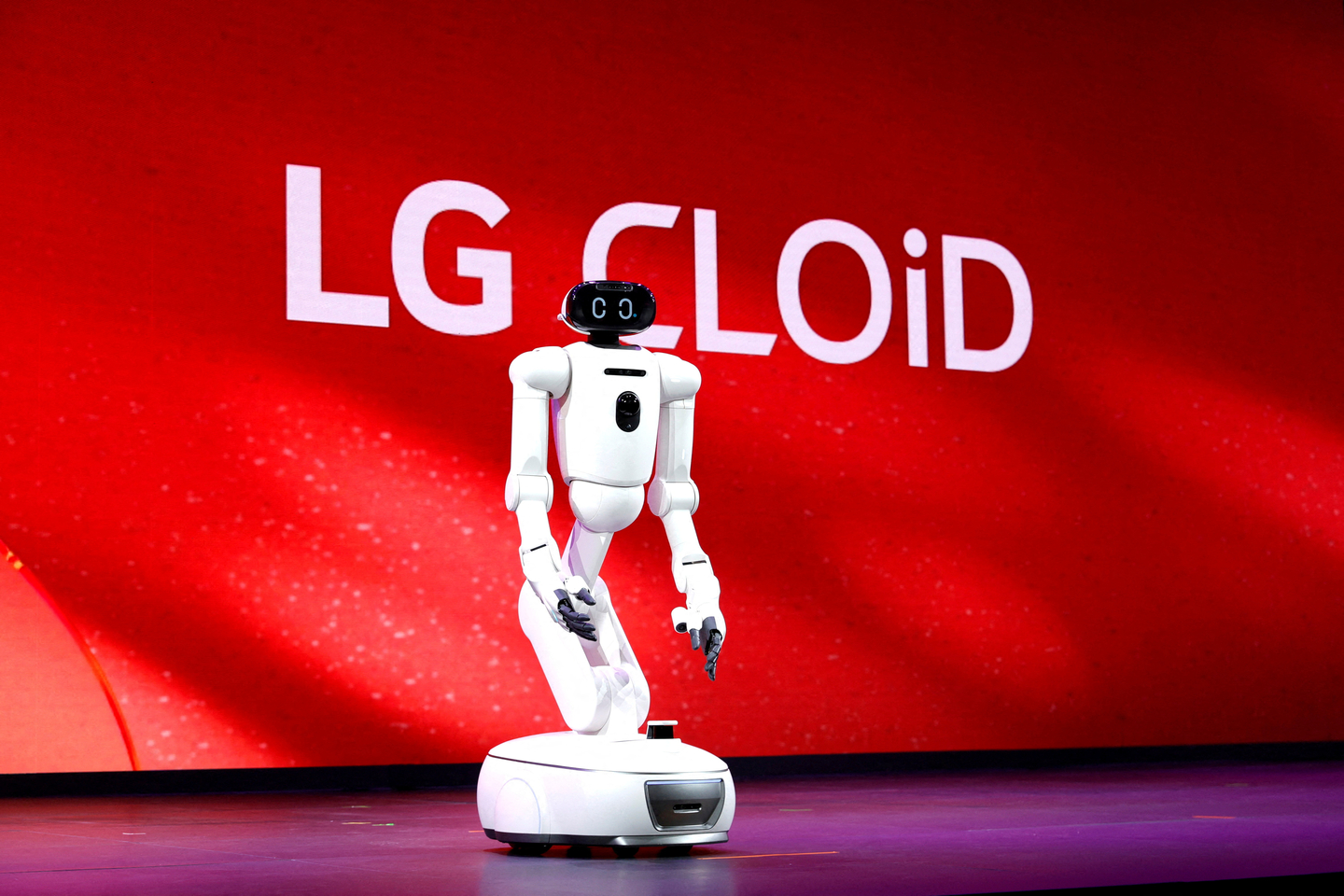
Actuators, or the joints that dictate how precisely a robot can move, have become the new battleground in the race to build humanoid robots, pushing major Korean conglomerates to expand into a sector once dominated by smaller firms.
The components, which combine motors, reducers, controllers and sensors, determine the extent — including the force, speed and angles — to which a robot can walk, grip objects and maintain its balance. They also account for 30 to 50 percent of a humanoid robot’s manufacturing cost.
As humanoid robots grow more complex, they require more actuators. Tesla CEO Elon Musk said last November that future units could each possess more than 50 actuators to become what he described as “extremely complex” structures. Tesla’s Optimus, unveiled in 2022, uses 28 actuators. A next-generation version would likely nearly double that number.
Conglomerates accelerate push into actuator production
Korean conglomerates are moving to secure a foothold.
LG Electronics, which introduced its humanoid robot Cloid at CES 2026 in January, launched a new robotics actuator brand called Axiom. The company is developing the products under its component solutions division, targeting a launch next year.
LG Electronics plans not only to supply actuators for Cloid but also to secure orders from external clients, allowing the company to apply decades of motor durability design and mass production expertise.
![An LG Cloid robot folds laundry at the LG Electronics booth at CES 2026 in Las Vegas on Jan. 6. [AP/YONHAP]](https://koreajoongangdaily.joins.com/data/photo/2026/02/20/615f1f68-858c-4f5c-b4b0-6237e1862624.jpg)
An LG Cloid robot folds laundry at the LG Electronics booth at CES 2026 in Las Vegas on Jan. 6. [AP/YONHAP]
Hyundai Mobis has already joined the supply chain by securing a contract to supply actuators for Boston Dynamics’ humanoid robot Atlas and plans to mass-produce 30,000 units in 2028, leveraging its large-scale manufacturing experience and quality control capabilities. Boston Dynamics is an affiliate of Hyundai Motor Group.
Samsung Electro-Mechanics has also entered the actuator sector by investing in Alva Industries, a Norwegian manufacturer of ultracompact high-performance electric motors, building on its precision component manufacturing expertise.
Large corporations have entered the actuator industry, which was previously led by small- and medium-sized enterprises and startups due to its profitability and growth potential.
High margins and rapid market growth
Actuators account for 30 to 50 percent of the materials cost for humanoid robots, according to Interact Analysis, a Britain-based market research firm, but some industry observers place the figure near 60 percent.
The market is also expanding rapidly. Industry insiders expect global demand for humanoid robot actuators to rise from $150 million in 2024 to $9.86 billion in 2031 — an average annual growth rate of 80 percent.
Meanwhile, geopolitical shifts may create opportunities for Korean firms.
Supply chain realignment reshapes competition
The Trump administration is considering an executive order this year to tighten robotics industry regulations and reduce reliance on Chinese components, according to U.S. political online newspaper Politico.
“As demand for humanoid robots surges while more companies call for supply chains that exclude China, a single-supplier system can no longer handle the volume,” said Kang Sung-jin, an analyst at KB Securities. “There is a clear shift toward securing multiple suppliers at the same time.”
![Boston Dynamics Atlas robots are displayed an the Hyundai Motor Group booth during CES 2026 in Las Vegas on Jan. 6. [REUTERS/YONHAP]](https://koreajoongangdaily.joins.com/data/photo/2026/02/20/7ecd7c22-1945-4d7e-9aa0-6320a1958dec.jpg)
Boston Dynamics Atlas robots are displayed an the Hyundai Motor Group booth during CES 2026 in Las Vegas on Jan. 6. [REUTERS/YONHAP]
But challenges remain. The Korea International Trade Association said in January that localization rates for robot materials and components in Korea remain in the 40 percent range.
Prototypes of Hyundai Motor Group’s Atlas and LG Electronics’ Cloid, both of which were displayed at CES 2026, also used foreign-made actuators.
In the global actuator market, leading players include Harmonic Drive Systems and Nabtesco of Japan, Maxon of Switzerland and Wittenstein of Germany.
“To grow the domestic robot market, actuator companies must strengthen their own competitiveness and expand cooperation with robot manufacturers,” said Kwon Myung-jun, an analyst at Yuanta Securities.
Originally written by: KIM SU-MIN
Source: Korea JoongAng Daily
Published on: 20 February 2026
Link to original article: Actuators become new battleground in humanoid robot race
