
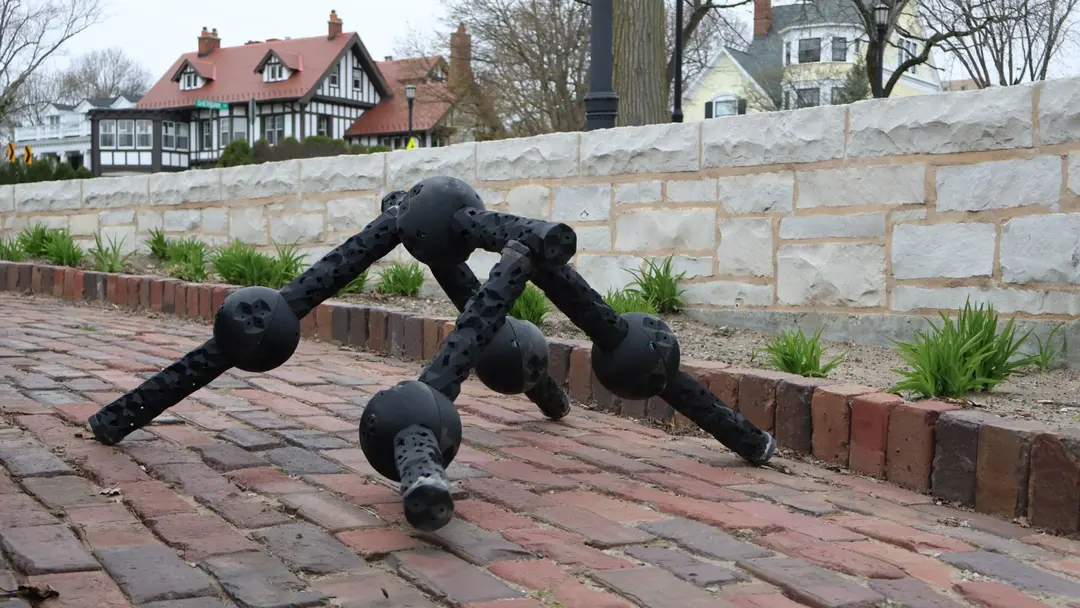
Engineers at Northwestern University have developed a new class of modular robots called “legged metamachines.”
These machines possess built-in athletic intelligence that adapts on the go.
The robots are composed of autonomous, Lego-like modules. Each module contains its own circuit board, battery, and motor. While a single module can roll and jump, its true power emerges when they snap together.
In particular, the core components consist of half-meter-long modular limbs, with a central sphere connecting two elongated, stick-like segments.
“Inside the sphere, the robot has everything it needs to survive: a ‘nervous system,’ a ‘metabolism’ and ‘muscle,’” said Sam Kriegman, the lead author.
“By that, I mean a circuit board, a battery, and a motor. The modules are mechanically simple. They can only rotate around a single axis, but they are surprisingly athletic and smart,” the researcher added.
AI-created design
To find the best shapes for movement, Kriegman’s team used an evolutionary algorithm.
It simulated a Darwinian process of mutation and selection. The AI bypassed standard human designs to evolve high-performing body types in which modular parts assume specialized roles.
The result is bizarre, alien-looking modular machines that no human engineer would have dared to sketch on a whiteboard.
Interestingly, these new breeds of robots mirror movements of the natural world, shifting from the rhythmic undulations of a seal to the rapid bounding of a lizard or the powerful, coiled springs of a kangaroo.
These metamachines are built from independent robotic units to perform complex acrobatics and survive extreme damage that would be fatal to standard designs.
Rather than failing when broken, these robots simply reconfigure; severed parts remain autonomous, continuing to move until they can rejoin the collective.
“These are the first robots to set foot outdoors after evolving inside of a computer,” said Kriegman.
“They are rapidly assembled and then quite literally hit the ground running. They can move freely in the wild and easily recover from major injuries that would be fatal to every other wild robot. If flipped upside down, they instinctively bring themselves upright and continue their journey. They can survive being chopped in half or cut up into many pieces. When separated, every module within the metamachine can become an individual agent,” Kriegman explained.
Assemble, repair, recombine
To validate the AI’s designs, Kriegman’s team built physical three-, four-, and five-legged prototypes and tested these across various outdoor terrains, from shifting sand to tangled tree roots.
These metamachines demonstrated autonomy, performing flips and jumps without any manual recalibration.
The most striking feature, however, is their functional immortality. As each metamachine is essentially a “robot made of other robots,” catastrophic damage isn’t fatal.
If a leg is severed, the main body recalibrates its gait instantly. Meanwhile, the severed limb doesn’t become dead weight. It remains an autonomous agent, rolling and crawling across the terrain until it can rejoin its team.
“It can sense its surroundings, move from place to place, compute and learn,” Kriegman said.
“Metamachines can be rapidly assembled, repaired, redesigned and recombined. Once assembled, they immediately move themselves across a wide array of unstructured environments,” he added.
This research could lead to robots capable of self-repair and rapid reconfiguration, as well as machines for extreme settings in the future.
The study was published in the journal Proceedings of the National Academy of Sciences.
Originally written by: Mrigakshi Dixit
Source: Interesting Engineering
Published on: 9 March 2026
Link to original article: New modular robots can flip, jump, and keep moving even after being cut into pieces
