
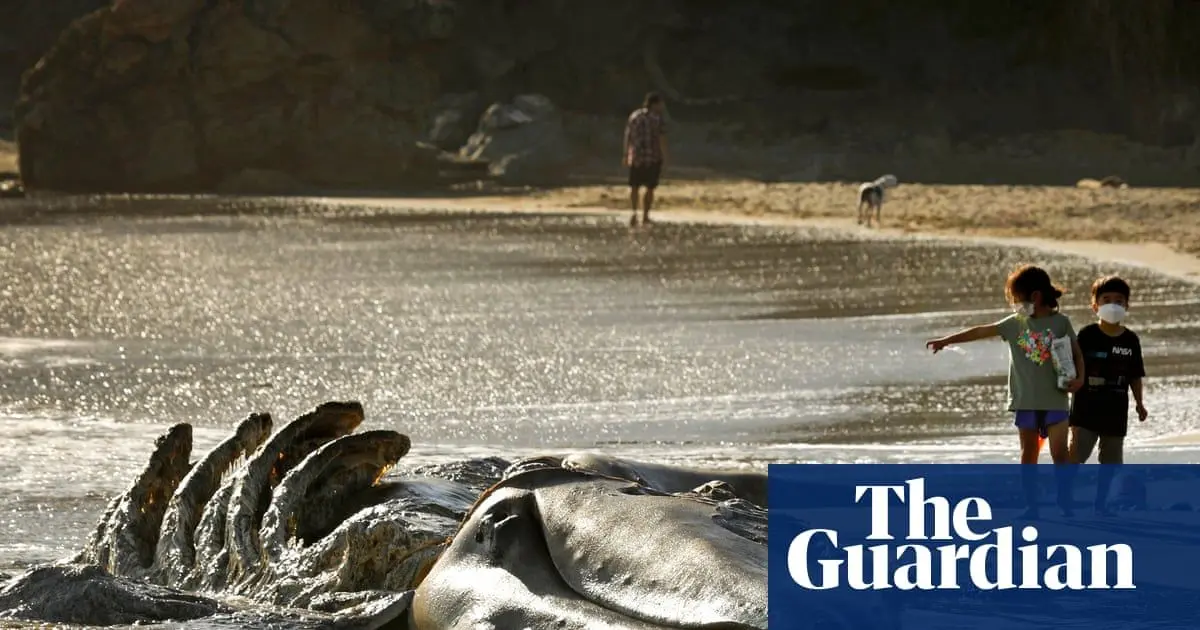
An artificial intelligence-powered detection network launched this week in San Francisco Bay to track gray whales around the clock, aiming to prevent deadly vessel collisions as climate change drives malnourished whales into busy shipping lanes, as reported by The Guardian.
The system, called WhaleSpotter, scans the estuary up to 2 nautical miles away using thermal cameras and automated alerts to notify mariners of nearby whale activity, responding to an alarming rise in whale deaths within the area.
Data from the Marine Mammal Center shows 21 dead gray whales were found in the wider Bay Area last year, marking the highest toll in 25 years, with at least 40% killed by ship strikes.
At least 10 more whales have died in the region so far this year, though scientists warn these figures underestimate the true toll because many carcasses sink or drift out to sea undetected.
Warming temperatures and shifting sea ice in the Arctic are disrupting the food web, leaving gray whales malnourished and forcing them to divert into the crowded bay instead of passing offshore during their 12,000-mile migration.
National Oceanic and Atmospheric Administration records indicate the eastern north Pacific gray whale population has plummeted by half over the last 10 years, leaving just 13,000 remaining.
“They’ll be able to make adjustments way before they get anywhere close,” said Thomas Hall, director of operations for the San Francisco Bay ferry.
The system also collects long-term data to help transit operators permanently adjust their routes around whale habitats during peak seasons.
“It will also allow us to track data over time and see where the whales are camping out so we can adjust our routes during whale season to avoid those areas completely.” said Thomas Hall, director of operations for the San Francisco Bay ferry.
The current whale concentrations overlap heavily with ferry routes and cargo lanes in a high-traffic corridor between Angel Island, Alcatraz, and Treasure Island.
“It’s the worst place possible in terms of all the ship traffic,” said Rachel Rhodes, a project scientist at the Benioff Ocean Science Laboratory who led the initiative.
The high frequency of collisions has left local stranding response teams completely overwhelmed.
“The teams responding to strandings said they ran out of places to even land dead whales.” said Rachel Rhodes, a project scientist at the Benioff Ocean Science Laboratory who led the initiative.
The AI automatically flags heat signatures and whale blows, which are verified by human observers before being broadcasted via radio to vessel controllers and posted online.
“They may not be getting the quality or quantity of food they’re used to in the Arctic,” said Rachel Rhodes, a project scientist at the Benioff Ocean Science Laboratory who led the initiative.
This nutritional deficit leaves the migrating whales highly vulnerable as they enter the perilous, high-traffic shipping lanes.
“That means they’re starting this incredibly long migration at a disadvantage.” said Rachel Rhodes, a project scientist at the Benioff Ocean Science Laboratory who led the initiative.
While similar systems exist globally, this network is the first to directly integrate land-based and vessel-mounted detections with official mariner alerts in near-real time.
“Suddenly to have a full sense of how much whale activity in this space honestly put me a little bit on edge,” said Douglas McCauley, director of the Benioff lab.
The team plans to use this influx of tracking data to establish a smarter, safer way to share the bay waters.
“But we’re going to use that data and we’re going to be smart about how we use that space and share it with the whales.” said Douglas McCauley, director of the Benioff lab.
Beyond ship strikes, whales face severe entanglement hazards along the coast due to tens of thousands of vertical lines from the Dungeness crab fishery.
A severe marine heatwave has shrunk nutrient-rich coastal zones, driving humpback whales closer to shore where these crab traps operate.
“Humpbacks are curious and they’ll scratch their backs on the gear,” said Kathi George, director of cetacean conservation biology at the Marine Mammal Center.
When whales become entangled, they often roll and worsen the entrapment, dragging heavy commercial fishing gear for months.
“If they get a line caught on their body, they’ll breach and they’ll roll and end up entangling themselves.” said Kathi George, director of cetacean conservation biology at the Marine Mammal Center.
NOAA confirmed 36 whale entanglements off the West Coast in 2024, the highest number since 2018.
To mitigate this threat, California approved the commercial use of ropeless pop-up crab gear this spring, allowing fishermen to trigger an acoustic release that brings traps to the surface without surface lines.
“We will have to continue to be adaptive and science driven in terms of our management to reduce wildlife risk and keep fishermen on the water,” said Caitlynn Birch, Oceana’s Pacific campaign manager and a marine scientist.
Environmental scientists hope California’s adoption of whale-safe fishing technologies will serve as a model for other fisheries across the United States.
“California has been a national leader in developing whale-safe fishing technologies and we hope that model can help guide other fisheries on the West Coast and nationally.” said Caitlynn Birch, Oceana’s Pacific campaign manager and a marine scientist.
Originally written by: Arya Pratama
Image credit: Carolyn Cole/Los Angeles Times via Getty Images
Source: Asatu News
Published on: 21 May 2026
Link to original article: Artificial Intelligence System Tracks Whales to Prevent Ship Strikes
