

Jensen Huang, chief executive officer (CEO) of Nvidia, who will visit Korea on the 4th, will meet with officials from the domestic robotics industry. He is said to be planning to discuss ways to expand cooperation in physical AI with startups and researchers that are applying Nvidia’s Robotics platform to actual product development.
According to the industry on the 2nd, Huang will hold a closed-door roundtable on the 8th in Korea as his final official engagement, inviting CEOs of domestic robotics and AI startups that have worked with Nvidia, robotics and physical AI researchers, and partner representatives to the Shilla Hotel in Jangchung-dong, Seoul.
This will be Huang’s first time meeting domestic robotics startups and academic figures together in one place. The event will be attended by corporations that took part in Nvidia’s startup incubation program, robotics and next-generation network AI researchers, and representatives of domestic corporations that have applied Nvidia technology to products and services.
From the startup sector, AeiROBOT, NdotLight, and RealWorld are expected to attend. They were selected for the “Inception Grand Challenge,” in which Nvidia chooses and supports startups that developed services using its technology and show high potential for commercialization.
AeiROBOT is developing a Humanoid Robot for shipbuilding and construction sites by applying Nvidia’s AI computer for robots and virtual training platform to its Humanoid Robot “Alice.” NdotLight is a corporations that creates 3D synthetic data for robot training using Nvidia’s simulation platform and has recently been collaborating with AeiROBOT on a project to develop a Humanoid Robot for manufacturing sites. RealWorld is building robot control models for manufacturing and logistics sites using Nvidia’s robot development platform.
In addition, CEOs from more than 30 startups in the robotics and Digital Twin fields that are using Nvidia’s AI technologies will attend. An industry official said, “We received an invitation stating that only one representative per company can enter,” and added, “As this is the first occasion where Huang will meet domestic robotics startup CEOs separately, corporations are preparing to explain how they use Nvidia’s technologies and potential avenues for further cooperation.”
From academia, researchers with ties to Nvidia in robotics and physical AI—such as the Seoul National University Robotics Institute, KAIST AI and Robotics researchers, and Yonsei University AI-RAN researchers—were reportedly invited. Key representatives from corporations collaborating with Nvidia in Robotics and manufacturing AI, including Hyundai Motor Group, were also said to have been invited.
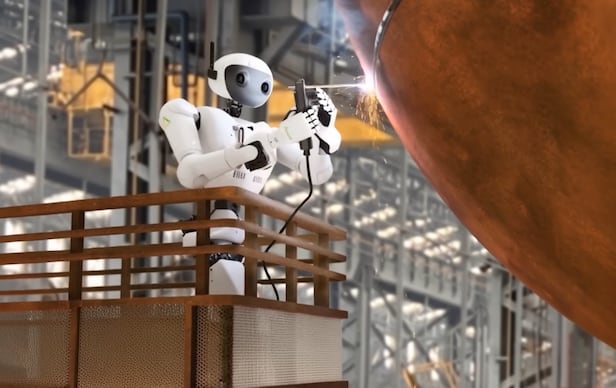
AeiROBOT’s Humanoid Robot Alice appears in the opening video of NVIDIA CEO Huang Jensen’s keynote at CES 2026 in January this year. The scene visualizes a future scenario of performing ship welding./Courtesy of NVIDIA YouTube capture
Huang has recently expressed his intention multiple times to cooperate with Korea’s robotics industry. Meeting with reporters at “GTC 2026,” Nvidia’s annual AI conference held in Taipei, Taiwan, the previous day, he said, “Korea is a very important place in our ecosystem,” adding, “Beyond simple chips, we are already working together in DRAM, science, Robotics, and AI factory fields, and there is truly a lot more we will do together going forward.”
In particular, he cited the robotics industry as a key area of cooperation with Korea, saying, “Robotics is a very important field for Korea’s future, and Nvidia hopes to contribute to the development of Korean Robotics.”
The industry expects Huang’s visit to Korea to serve as a catalyst for more concrete discussions on physical AI cooperation between Korean corporations and Nvidia.
Because physical AI performance is advanced based on data generated in real sites such as factories, shipyards, and logistics centers, Korea, which has a diverse manufacturing base, is considered by Nvidia as a market with significant room for collaboration. Korea has a broad industrial base not only in semiconductors but also in automobiles, shipbuilding, and electronics, enabling the creation and verification of on-site data, which is core to physical AI development.
An industry official said, “The competitiveness of physical AI depends on how widely it can generate and apply data across diverse manufacturing sites,” adding, “The fact that Huang will meet not only large domestic corporations but also startups and academia during this visit means he sees Korea not just as a buyer of AI infrastructure, but as a partner to implement physical AI together.”
Originally written by: Choi Ji-hui
Image credit: Courtesy of Reuters Yonhap News
Source: ChosunBiz
Published on: 2 June 2026
Link to original article: Huang meets South Korea robotics leaders to deepen physical AI collaboration
