Artificial intelligence is inventing new drugs against Parkinson’s disease, antibiotic-resistant superbugs and many rare diseases – progress that many scientists never dreamed possible.
For around half a century, humanity has been slowly losing its battle against bacteria. The most powerful weapons we have in this fight, antibiotics, are increasingly ineffective as drug resistance spreads. Around 1.1 million people now die every year from infections that were until recently easily treated. And the death toll is expected to rise to more than eight million by 2050 unless urgent action is taken.
Developing new antibiotics is a frustratingly slow and expensive process. Between 2017 and 2022, just 12 new antibiotics were approved for use, the majority of which were similar to existing drug-types that bacteria are already developing resistance to. The field has been chronically neglected due to a lack of interest from drug companies and underfunding.
But now researchers are looking to close the gap – and some are betting on artificial intelligence to help them do it.
“We can – in a matter of days or hours – look at massive libraries” of chemical compounds to identify those that display antibacterial activity, says James Collins, professor of medical engineering and science, at Massachusetts Institute of Technology in Cambridge, US. With the help of AI, Collins and his team have already discovered two new compounds that could prove vital weapons against the highly drug-resistant infections gonorrhoea and MRSA.
It is just one example of how AI is opening up a new era of drug discovery – promising progress on some of the most intractable medical problems of our time. Scientists are now pointing AI at conditions with no known cure such as Parkinson’s Disease, and thousands of rare diseases, in the hope of new breakthroughs.
Collins and his team trained a generative AI model to recognise the chemical structures of known antibiotics. This allowed the algorithm to learn what it takes to kill bacteria. The researchers then used the AI to screen more than 45 million different chemical structures for their ability to target Neisseria gonorrhoeae, the bacteria that cause gonorrhoea, and Staphylococcus aureus, a significant source of infections in the form of MRSA.
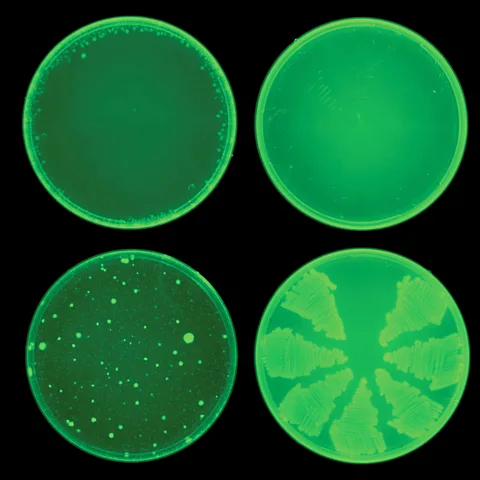
James Collins’s team have used AI to identify new compounds that can kill multiple bacteria (top row) that are resistant to other drugs (bottom row) (Credit: Collins Lab/ MIT)
Both of these bacteria are highly drug-resistant – in the case of gonorrhoea, it’s able to evade almost every medicine used to treat it. There are now a dwindling number of antibiotics available – drugs of last resort – to wield against each.
Collins’ method used AI to create entirely new compounds to target the bugs. In one approach, he selected a molecule as a starting point and used a combination of generative AI techniques to build it out, “adding bonds, atoms, substructures”, he says. At each critical stage, the compound was scored by his trained AI model: “Is this looking like an antibiotic? Is it getting closer to a potential antibiotic?” Another approach involved dispensing with the starting compound and letting the AI freestyle from the beginning.
Collins and his colleagues designed 36 million compounds in this way with potential to work against the bacteria. The team selected 24 to synthesise in a laboratory. Seven proved to have some antimicrobial activity, and two were highly effective at killing strains of both bacteria that were resistant to other types of antibiotics.
Importantly, the compounds appear to target the bacteria in different ways to already existing antibiotics, raising hopes they could form a new class of medicines able to overcome the defences of drug-resistant bacteria. The two candidates are currently undergoing further testing.
Collins and his laboratory have previously used AI to discover other powerful new antibiotic compounds that kill a wide range of bacteria that are resistant to treatment, including Clostridium difficile, a common bowel infection, and Mycobacterium tuberculosis, which causes tuberculosis.
For some diseases, however, researchers don’t have the luxury of drawing upon existing drugs to help them find new treatments. Instead, they need to start with what is known about the disease itself. In some cases, however, even that gives them little to go on.
Progress on Parkinson’s
Parkinson’s Disease was first identified in 1817, but more than two centuries later, there is still no treatment that slows the progression of the illness. There are more than 10 million Parkinson’s patients worldwide, and rates are rising in countries with ageing populations. About one in 37 people in the UK will be diagnosed at some point in their lives. In the US, up to one million people currently live with the disease.
The long-running efforts to treat Parkinson’s are littered with failure. Part of the problem is we still don’t know what causes the disease.
“There are endless debates about the origin of the disorder,” says Michele Vendruscolo, professor in biophysics and co-director of the Centre for Misfolding Diseases at the University of Cambridge in the UK. “If you go to a Parkinson’s conference, you will hear dozens of different hypotheses that are all actively investigated.”
Vendruscolo hopes that one day, AI could help to halt Parkinson’s before it begins
That makes targeting a drug to prevent the disease incredibly difficult.
There have been a huge number of clinical trials investigating different hypotheses, but to date, they’ve been unsuccessful, says Vendruscolo. “People are really confused about what the target should be,” he says. “Even if you know the target, it’s typically very difficult to go after it.”
But in 2024, Vendruscolo and his colleagues published a study where they used machine learning – a form of artificial intelligence – to search for potential drug candidates able to target the clumps of misfolded proteins in the brain that occur in Parkinson’s patients. The aggregations of proteins, known as Lewy bodies, are thought to play a role in the initial stages of neurodegeneration in Parkinson’s patients, eventually leading to symptoms including tremors, slowness of movement and muscle stiffness.
Right now, the most effective treatment for Parkinson’s is Ledovopa, a drug that helps to improve the symptoms of the disease but can also cause side-effects such as involuntary movements.
Vendruscolo is focused on halting the progression of the disease itself. He and his team started with a set of compounds that had already been identified as potentially effective in the treatment of Lewy bodies. He fed these into a machine learning program, which extrapolated from their chemical structures to propose new compounds that might also be effective.

David Fajgenbaum has tried to find cures among existing drugs after discovering a treatment for his own rare illness in medicines approved for other uses (Credit: Getty Images)
To treat neurodegenerative diseases like Parkinson’s, drugs need to be small enough that they can pass through the blood-brain barrier. But even if scientists restrict their drug hunt to small molecules, “you still have a humongous amount of choice”, says Vendruscolo. “The number of possible small molecules is far larger than the number of atoms in the Universe.”
The power of AI is that it can very quickly narrow down that search.
“We can analyse this data and make very accurate predictions about the way candidate molecules will bind to the target at a scale that was unthinkable until a few years ago,” says Vendruscolo. With more traditional methods, scientists could screen around one million molecules in six months at the cost of several million pounds. “Now, you can do the same in a few days but screen billions of molecules, for the cost of a few thousand pounds.”
Vendruscolo’s AI-suggested compounds were then tested in the lab. “We measured which of the candidates were actually binding [to the Lewy bodies], and we fed this information back into the machine learning program, so it could learn from its own mistakes,” he says.
They ended up identifying five promising new compounds more quickly and effectively than conventional approaches. The compounds identified by the AI were also far more novel than would have been found using more traditional drug development methods, says Vendruscolo. They are now undergoing further testing to assess whether they could one day be offered as a therapeutic to Parkinson’s patients.
Vendruscolo hopes that one day, AI could help to halt Parkinson’s before it begins. He is now using the technology to find small molecules that bind to the individual proteins that form Lewy bodies while still in their normal state.