
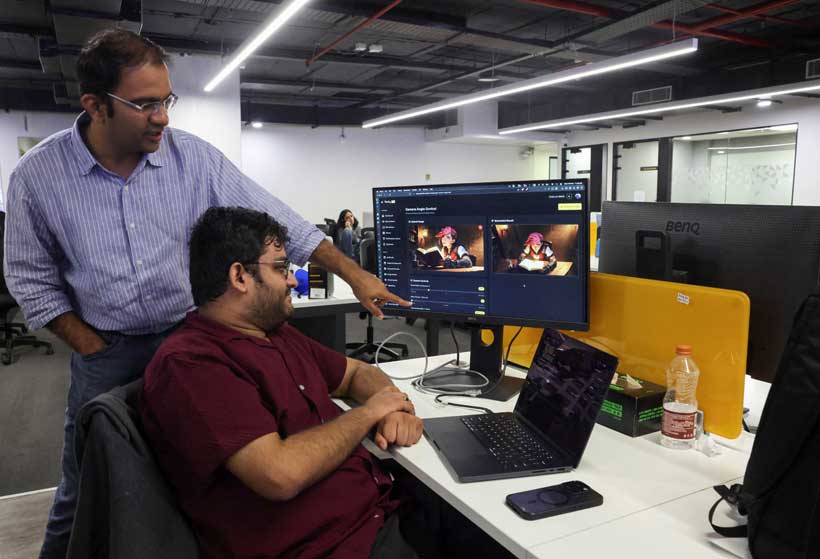
The Collective Artists Network, a prominent talent agency in Bollywood, is now focusing on creating digital content using artificial intelligence (AI) at its Bengaluru studio. Filmmakers are using AI tools to produce movies based on Hindu mythology, including scenes from the “Ramayana” and “Mahabharat. ” Despite producing the most movies globally, India faces challenges as audience habits shift towards streaming, resulting in a drop in moviegoers from 1.03 billion in 2019 to 832 million in 2025, according to Ormax Media. Although box-office sales reached $1.4 billion last year, revenue has been unstable since the pandemic.
Studios in India are significantly adopting AI, creating fully AI-generated films, using AI for dubbing in multiple languages, and recutting films to increase sales. This shift is drastically reducing production costs and timelines, with Rahul Regulapati from Collective’s AI studio, Galleri5, noting costs have plummeted to one-fifth of traditional filmmaking and production time is down to a quarter.
In contrast to Hollywood, where union contracts limit AI use, Indian studios are embracing AI more fully. Major production houses are reviewing their libraries for AI re-releases, and tech companies like Google, Microsoft, and Nvidia are partnering with local filmmakers. Reports indicate that India’s film industry is reorganizing around AI, driven by economic factors.
Additionally, AI has the potential to boost revenue for Indian media and entertainment firms by 10% while reducing costs by 15%, according to EY. Vikram Malhotra from Abundantia Entertainment shared plans for a new $11 million AI studio, expecting AI-generated content to contribute to one-third of the company’s revenue in three years.
New endings for old dramas
Last year, India’s Eros Media World re-released the 2013 film “Raanjhanaa” with an AI-altered ending, changing the original tragic conclusion to a happy one where the protagonist wakes up to his lover’s smile. This alteration faced criticism, including comments from lead actor Dhanush, who stated that the remake removed the film’s essence and set a troubling precedent for both art and artists. However, the re-release was successful, with 35% of tickets sold for the Tamil-language version during August, surpassing the average of 12%.
Eros Media World plans to expand its efforts, with CEO Pradeep Dwivedi announcing a review of its 3,000-title catalog to find candidates for AI-assisted adaptations. The studio’s Indian branch, Eros International, reported a 44% drop in consolidated annual revenue and sees AI rewrites as both a business opportunity and a way to rejuvenate creativity. In contrast, Hollywood studios face restrictions on altering actors’ performances or creating digital replicas without consent due to agreements with labor unions, ensuring that AI does not replace the creative roles of directors and crew.
Indian studios are more willing to experiment with AI. Collective is working on eight AI-generated titles based on Hindu deities. Additionally, JioStar, a partnership between Mukesh Ambani’s Reliance and Walt Disney, has launched an AI-generated adaptation of the Hindu epic “Mahabharat,” which has gained over 26.5 million views on its streaming platform since October. Despite its popularity, the show has received poor ratings on IMDb, notably a score of 1.4, with viewers citing issues like lip-sync errors and lack of authenticity.
JioStar’s Alok Jain remarked that the reaction has led to a healthy debate on AI’s role in creative industries. Some industry figures, like Jonathan Taplin, criticize the use of AI in filmmaking, arguing that it undermines the history of cinema and could lead to low-quality content.
Dubbing poses a potentially easier area for AI integration due to India’s diverse linguistic landscape, which requires dubbing for films to become national hits. AI technology is addressing long-standing issues with mismatched lip movements. A Bengaluru-based company, NeuralGarage, demonstrated how its AI can create seamless dubbing, illustrated with a Hindi film dubbed into Telugu.
Global tech companies are also interested in AI in filmmaking. Google partnered with Bollywood director Shakun Batra to create a five-part series using AI tools. Google’s vice president suggested that AI could help independent filmmakers create scenes that would otherwise be too costly. Collective is collaborating with Microsoft to advance AI in storytelling, utilizing motion capture and facial expression data to enhance character generation.
AI film festivals are rising globally, with India hosting its first in November at the Royal Opera House in Mumbai, featuring young creators and a dancing robot. Nvidia also participated in India’s AI film fest in February, focusing on making AI filmmaking more accessible. Bollywood director Anurag Kashyap expressed concern over AI usage in filmmaking but acknowledged that studios will likely adopt it for financial reasons, as audiences are drawn to mythological films enhanced by this technology.
With information from Reuters
Originally written by: Newsroom
Source: Modern Diplomacy
Published on: 5 April 2026
Link to original article: How AI is transforming Bollywood, the world’s busiest film industry
