
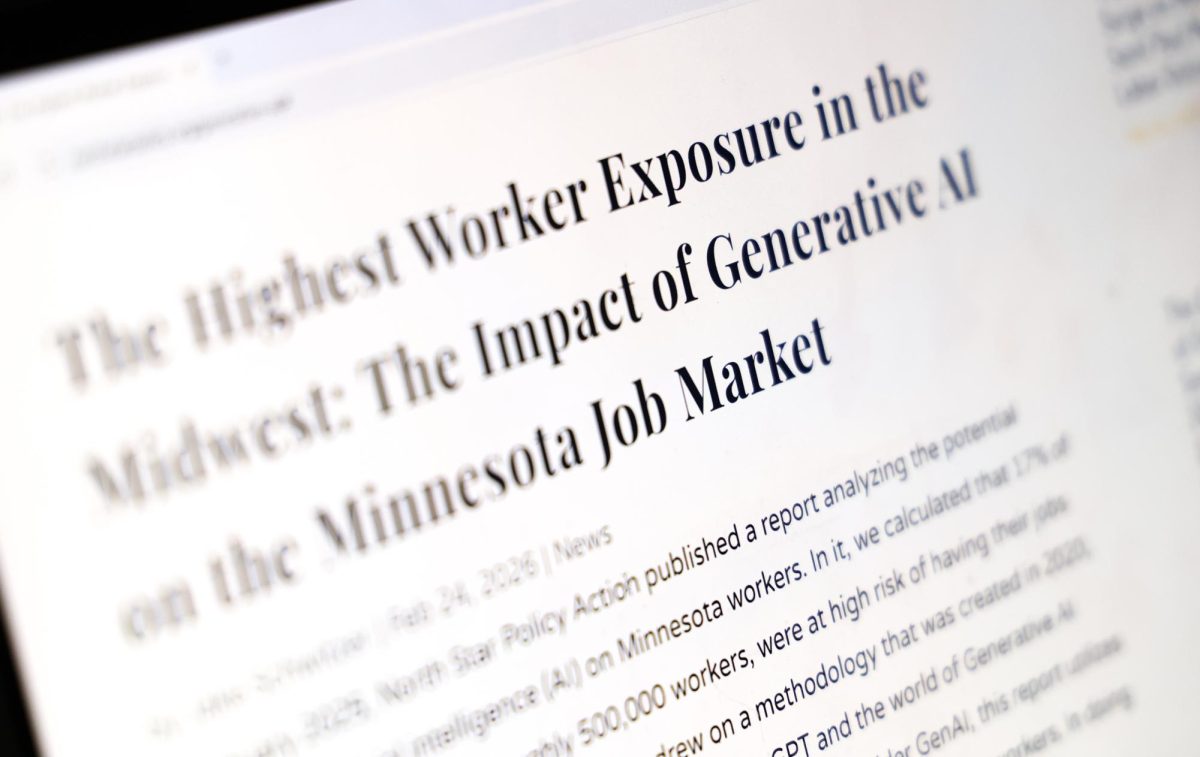
A report from North Star Policy Action says Minnesota workers have the highest generative AI exposure in the Midwest and the 10th-highest in the nation.
The report defines AI exposure as when half or more of a worker’s tasks could be partially or wholly accomplished by generative AI. According to calculations in the report, 17% of the state’s workforce, or roughly 500,000 workers, were at high risk of having their jobs altered or replaced by AI.
Rep. David Gottfried (DFL-Roseville) is one of the lawmakers who put regulating AI at the head of his priorities. In the 2026 legislative session, he sponsored several AI-related bills, including how artificial intelligence pertains to electronic monitoring and job displacement.
“While we have not yet seen large-scale layoffs or disruptions to the workforce because of artificial intelligence, I think pretty much every expert expects that it’s those sorts of disruptions are a matter of when, not if,” Gottfried said.
With the impact of AI on the job market being unpredictable, Gottfried said it is necessary to get ahead of the curve by creating AI deployment guardrails to protect workers.
Many industries anticipate, or already feel, the impact of artificial intelligence.
Benjamin Toff, professor at the Hubbard School of Journalism and Mass Communication and director of the Minnesota Journalism Center, said journalists are not currently being displaced by artificial intelligence — but a bigger challenge is AI-generated news summaries taking traffic away from news platforms.
“There’s less and less direct traffic going back to news organizations, and those kinds of effects are certainly being felt by most news organizations in a way, itself, having an impact on their capacity, their ability to continue to employ journalists,” Toff said.
On the flip side, Toff said journalists have a unique opportunity to build trust with the public by making themselves distinct from AI. They can invest resources in accuracy, confirm facts and have a real human being at the center.
Professor Galin Jones, the University’s newly appointed inaugural Vice Provost of AI, said people must prepare for the influx of AI in the workforce.
“What we’re seeing right now, by and large, is that instead of taking jobs, people who are prepared to use it in the workforce have more opportunity,” Jones said.
Jones added that the University, like all others, is currently grappling with how to best prepare students.
“I don’t think anybody has it completely figured out yet,” Jones said. “This is an exciting time because it’s a transition and we’re going to be developing new things along the way, but it’s also concerning.”
Jones said the University’s basic AI literacy training should get more advanced and more specific.
“You might imagine that somebody in journalism is going to use it quite differently than somebody in computer science. And we need to think carefully about how that is going to happen.”
Many students do feel concerned. One is fourth-year computer science student Wayde DeYoe, who said that generative AI lacks real benefits.
“There are tools driven with AI that are used in a helpful and not as harmful way, like data processing in the medical field,” DeYoe said. “But overall, I don’t like Gen AI. It’s not really helpful for trying to save money because we’ve seen, like SORA, the image generator by OpenAI, it would lose like $1,000,000 a day or something before they shut it down”.
DeYoe said he knows many people in school who rely heavily on AI to do their assignments, and therefore miss important learning.
“Less people have the skills and knowledge that go into the workforce for entry-level jobs, or even higher-level jobs,” DeYoe said.
Daigan Berger, a 2025 computer science graduate from the University, said in a statement that the biggest challenge with AI in the computer science and engineering job market is that the skills necessary to succeed are changing rapidly.
“In the past, knowing basic web development or app development was enough to get a junior-level role. Now, the actual coding can largely be done by AI models — Claude, ChatGPT — and these tools are getting more advanced with the ability to interact with desktops and continuously iterate and improve the code they write,” Berger said.
At the same time, Berger said an upside of the widespread AI integration in the field is that engineers need to spend less time on repetitive tasks, leaving more time to focus on what to build and the designs and algorithms to achieve it.
“The advice I would give is focusing on business classes, architecture classes and data structures/algorithms,” Berger said. “This will give new opportunities and roles related to focusing on the correct design and implementation of code and systems.”
Originally written by: Maja Holmen
Source: The Minnesota Daily
Published on: 5 April 2026
Link to original article: Report says Minnesota workers face highest generative AI exposure in the Midwest
