
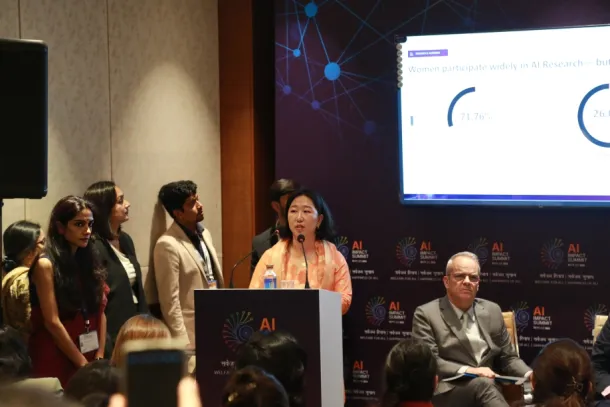
UNESCO in collaboration with the Women4Ethical AI (W4EAI) South Asia Chapter, UN Women, LinkedIn, The Quantum Hub and Amrita University, convened a panel titled “Women in AI: A South Asia Outlook on Representation, Equity & Empowerment” at the India AI Impact Summit 2026. The dialogue focused on advancing gender-inclusive and ethical AI ecosystems across South Asia.
Bringing together policymakers, researchers, industry leaders and civil society representatives, the session spotlighted emerging evidence from UNESCO’s forthcoming Gender & AI Outlook Study for South Asia, alongside insights from UN Women and LinkedIn’s Women and Future Jobs policy brief.
AI is no longer a distant technological frontier, but a structuring force in our economies, in our institutions, and in our everyday lives. But women continue to remain unevenly represented across the AI lifecycle — from data and design to development and deployment. Without deliberate and evidence-informed interventions, the systems we build today risk embedding and amplifying longstanding gender inequalities.
Preliminary findings from UNESCO’s forthcoming Gender & AI Outlook Study for South Asia reveal persistent gaps across workforce participation and research leadership.
AI Engineering Talent among LinkedIn users in 2024
in India were women.
in Nepal, reflecting a notable decline compared with India.
in Bangladesh, indicating a further drop.
AI Research Publications
of AI publications across Bangladesh, Bhutan, India, Maldives, Nepal and Sri Lanka include at least one female author.
have women as corresponding or primary authors.
Taking corresponding or primary authorship as a proxy measure of AI research leadership, the data signals a significant gap between participation and research stewardship.
The forthcoming report offers a comprehensive, data-driven regional assessment of women’s participation in the AI ecosystem across South Asia. Building on the Global Outlook study on AI and Gender (2024), the report examines women’s positioning across four interconnected domains: education and skilling pathways, workforce participation, research and academia, and digital access and infrastructure.
In doing so, it takes a lifecycle approach to map both structural enablers and systemic barriers shaping women’s engagement in AI ecosystems. The analysis also draws attention to persistent data gaps and inconsistent classifications that obscure the full extent of women’s contributions and constraints. The final report is scheduled for launch in June 2026.
Complementing these findings, speakers noted that AI-driven market shifts are accelerating job transformation. Women are disproportionately represented in roles vulnerable to automation, while underrepresented in core AI engineering positions. At the same time skills such as empathy, communication, and leadership are emerging as critical assets in an AI-augmented economy areas where women show strong representation.
The discussion highlighted the need to audit AI systems, expand women’s participation beyond STEM education into leadership and oversight roles, and recognise the often invisible labour of women within global AI value chains. Structural barriers such as limited early exposure to AI, infrastructure constraints, high connectivity costs, cultural expectations, and markedly low representation at senior levels were also discussed.
The panel reaffirmed that women across rural and urban contexts must be equipped for emerging roles in AI-driven economies, with stronger accountability and sustained advocacy to ensure gender remains central to AI governance.
Originally written by: UNESCO
Source: UNESCO
Published on: 3 March 2026
Link to original article: UNESCO and W4EAI South Asia Chapter Hosts ‘Women in AI’ Panel at the India AI Impact Summit 2026
