

The crypto market has been rocked by two major news stories that have industry players and investors on edge. Odds of Clarity Act Crypto 2026 on Polymarket plummeted from 82% to just 53%, signaling confidence in regulatory certainty is dwindling.
At the same time, the 15% global tariffs imposed through Trade Act Section 122 added to the macroeconomic pressure. The combination of these two factors sent the crypto Fear & Greed index plunging into the Extreme Fear zone, reinforcing the negative sentiment across the digital asset market.
Polymarket: Fall of Confidence on Crypto Clarity Act 2026
The drop in 2026 Crypto Clarity Act odds on Polymarket is not just a prediction market anomaly, but a strong signal that confidence in the certainty of crypto regulation in the United States is in crisis. For months, industry players and traditional financial institutions have pinned high hopes on this bill as a solution to the division of oversight between the Securities and Exchange Commission (SEC) and the Commodity Futures Trading Commission (CFTC).
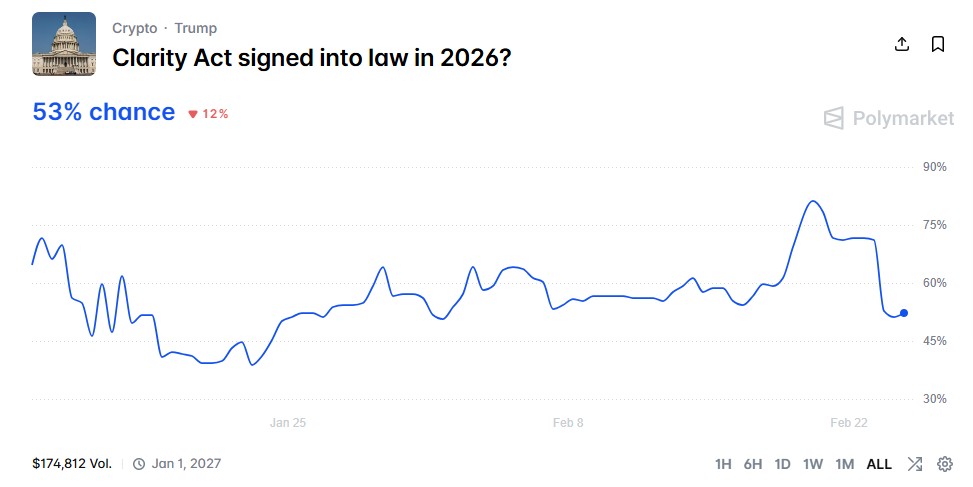
Source: Coinpedia
Many stablecoin issuers and large institutions have already prepared compliance strategies based on the Clarity Act’s promised framework. However, with the odds plummeting by 30 percentage points, institutional uncertainty now dominates market sentiment once again.
In the absence of legal certainty, fears of regulation by enforcement came back to haunt. Big banks started to hold back, while treasury desks chose to reduce risk. This phenomenon triggered a wave of FUD (Fear, Uncertainty, Doubt) among crypto market participants ahead of 2026. The crypto Fear & Greed index was stuck at 11-14, signaling a very pessimistic market atmosphere and approaching the point of capitulation.
Global Tariff of 15%: Macroeconomic Pressures Intensify
Amidst the political stalemate in Washington, the US government’s announced 15% global tariff policy has added a heavy burden to the crypto market. Although the Supreme Court had previously invalidated the old tariff authority, the government is now utilizing Trade Act Section 122 to impose new tariffs effective from February 24.
This policy immediately triggered inflationary fears and reinforced the narrative of longer-lasting high interest rates. As a result, liquidity in the market for risky assets such as cryptocurrencies was further depleted.
Crypto, which has often been treated as a proxy for high-volatility tech stocks, is particularly vulnerable to macroeconomic pressures like this. The bearish momentum is getting stronger, making investors and traders choose to hold back or even exit the market.
Many analysts believe that as long as tariff and regulatory uncertainties remain, it will be difficult for digital asset prices to recover. This situation also reinforces the perception that crypto is still far from being a stable hedge asset.
Price Pressure: Bitcoin, Ethereum, and Altcoins Take a Hit
Macro and regulatory pressures are directly reflected in the price movements of major cryptocurrencies. Bitcoin is now struggling to maintain support levels at $65,000, with $60,000 being the next crucial psychological threshold.
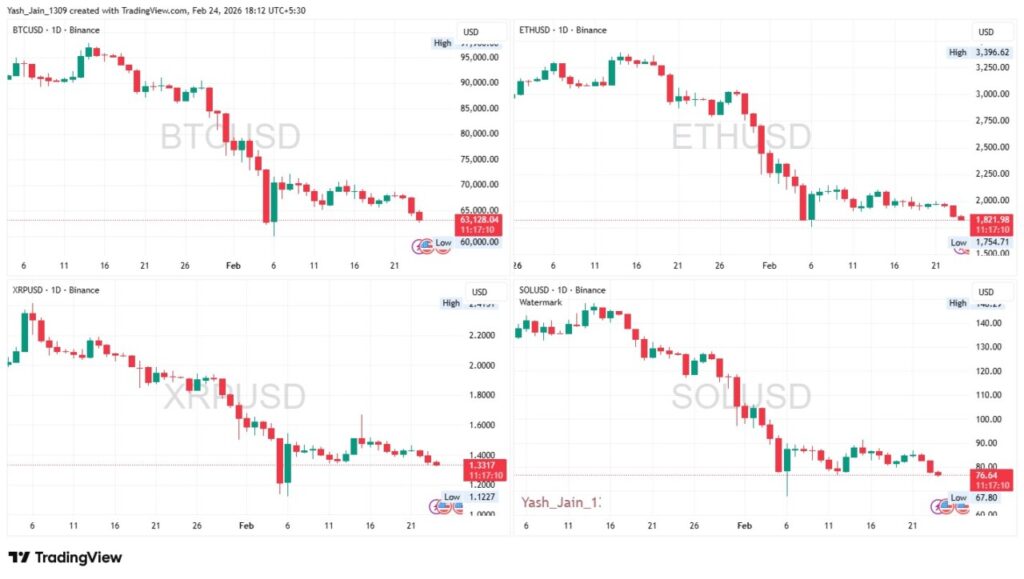
Bitcoin’s (BTC) identity as a hedging asset or simply a speculative instrument is being questioned once again amidst this turmoil. Ethereum also suffered a similar fate, having broken through the $1,890 level and now approaching $1,750, making the Real World Asset (RWA) and stablecoin narratives lose momentum.
Solana was not spared from the pressure, dropping to around $75 after previously breaking $80. Although developer activity in the Solana (SOL) ecosystem is still high, it has not been able to withstand the impact of macro shocks. Ripple, which has a unique regulatory history, is also under pressure and is now trading below $1.35, moving in line with the general market pressure. This shows that the negative sentiment has spread across almost all major cryptocurrencies, without exception.
Originally written by: Kezia Marcellova
Source: Pintu News
Published on: 25 February 2026
Link to original article: Clarity Act Crypto 2026 Freefall, 15% Global Tariff Triggers Crypto Market Panic?
