
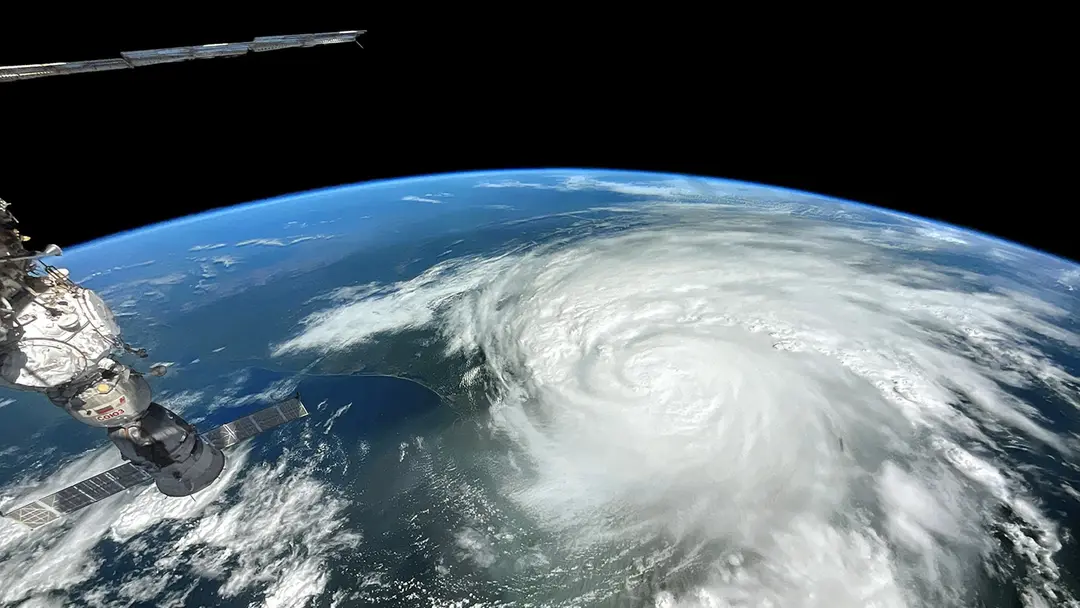
Hurricane Idalia did more than tear across Florida’s coastline in August 2023.
It reshaped the Gulf’s biological and chemical structure from the surface down to 50 meters below, and autonomous ocean robots were there to capture it.
A new study shows that satellites alone missed a critical part of the story.
While space-based sensors detected a surface chlorophyll bloom after the storm, underwater instruments revealed a second, hidden phytoplankton surge deeper in the water column.
To document the changes, researchers combined satellite data with a surface saildrone and a Biogeochemical Argo float operating below.
Together, they produced a three-dimensional view of how a powerful hurricane alters ocean productivity.
The findings show that pre-existing ocean features, including the Mississippi River plume, the Loop Current, and a nearby cyclonic eddy, determined how the Gulf responded once Idalia’s winds churned the water.
Robots map hidden blooms
The Mississippi River plume spreads nutrient-rich freshwater across the Gulf’s surface. Because freshwater is less dense than seawater, it creates a stratified layer that resists vertical mixing.
After the storm, this surface layer helped spread chlorophyll sideways, fueling an algae bloom visible from space.
But below the surface, a different process unfolded. Idalia’s winds intensified a nearby cyclonic eddy.
These spinning water masses naturally pull colder, nutrient-rich water upward in a process known as upwelling.
The storm amplified that upwelling, injecting nitrate into waters roughly 20 to 50 meters deep. That nutrient pulse triggered a second phytoplankton bloom that satellites could not detect.
The BGC-Argo float, which temporarily increased its profiling frequency from its standard 10-day cycle to every 18 hours, captured these subsurface chemical shifts.
It recorded changes in temperature, salinity, oxygen, and nitrate that revealed how the storm reorganized the Gulf’s interior layers.
“The deviation from the 10-day BGC-Argo mission to an 18-hour profiling frequency enabled our understanding of the biogeochemical changes under these unique conditions and highlights the importance of coupled ocean observations from the surface, subsurface, and from satellites,” said lead author Jennifer McWhorter.
Storms reshape ocean chemistry
The study shows that hurricane-driven mixing does not act uniformly. Instead, storm impacts depend heavily on existing circulation patterns and density structures.
In this case, the freshwater plume limited vertical mixing at the surface, while the energized eddy enhanced nutrient transport below. The result was a layered biological response: one bloom visible from orbit and another hidden beneath.
Primary production supports marine food webs and plays a major role in carbon dioxide uptake. Understanding how hurricanes influence that productivity is increasingly important as warming oceans fuel stronger storms.
The research also highlights a technological gap. Satellites provide broad coverage but cannot see beneath the surface.
Autonomous platforms such as saildrones and BGC-Argo floats fill that gap, delivering continuous measurements during extreme weather events that would be unsafe for crewed vessels.
By pairing space-based observation with robotic ocean systems, scientists were able to capture how a single hurricane rapidly restructured the Gulf’s biological and chemical landscape.
The study was published in the journal Frontiers in Marine Science.
Originally written by: Neetika Walter
Source: Interesting Engineering
Published on: 23 February 2026
Link to original article: Autonomous robots uncover hidden bloom altering carbon cycle of Gulf waters
