
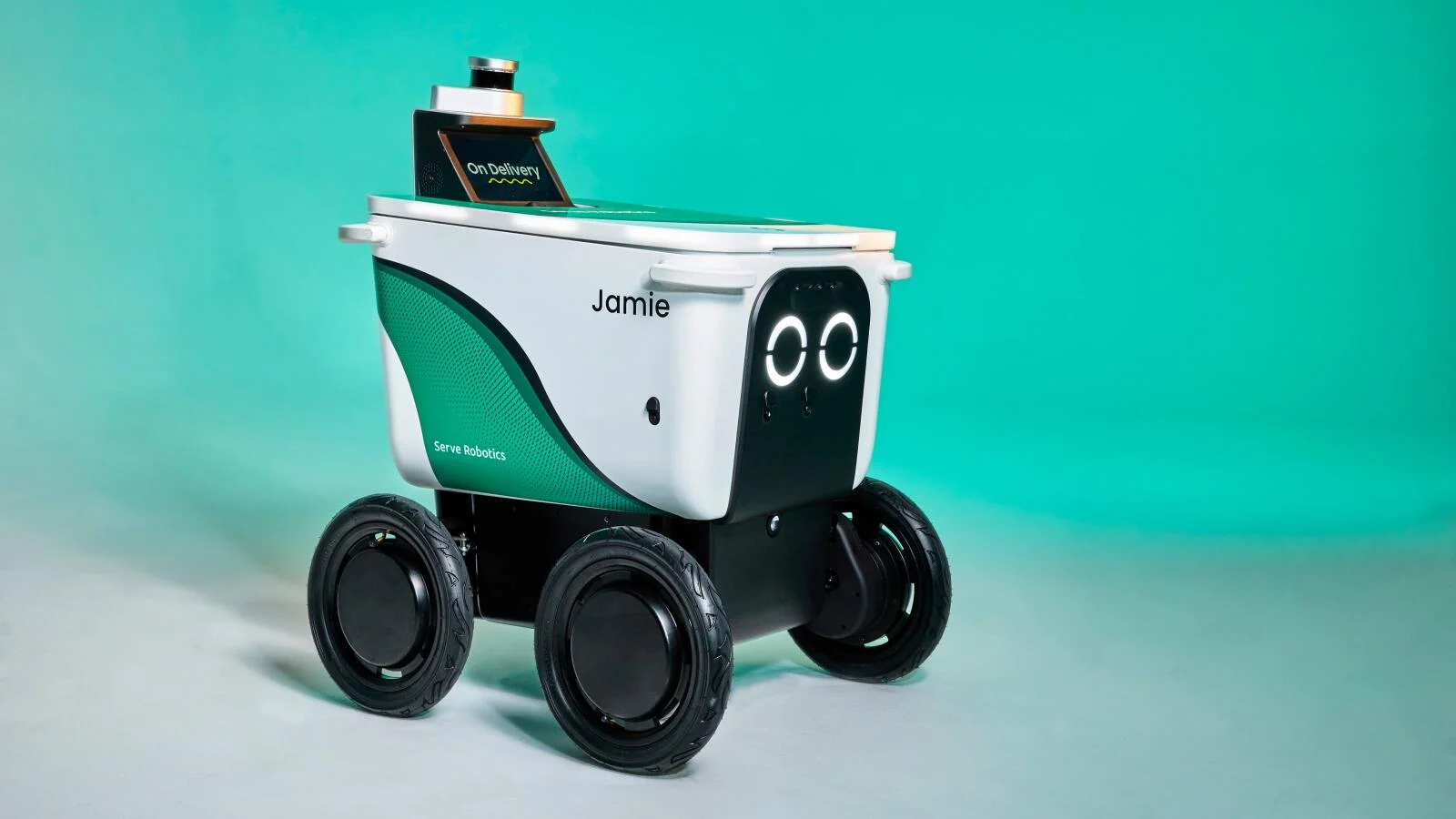
Having a small wheeled robot on a sidewalk deliver a burrito unsquished should be a simpler engineering problem than transporting people in a robotaxi. But companies operating delivery robots are discovering what any pedestrian could have told them: Many sidewalks are not only in bad shape but also poorly documented, with little or no maps of hazards.
“It’s not a data set that exists,” MJ Burk Chun, co-founder and VP of product and design at Serve Robotics, said in an interview at SXSW here. “It’s a data set that we’re collecting.”
The California-based firm has a fleet of 2,000-plus four-wheeled robots making deliveries for DoorDash, Uber Eats, and other clients in place of human couriers in cars or on bikes; customers place orders via those delivery services’ apps, then use them to track their delivery and open the hatch of a robot’s cargo compartment.
“That overgrown bush, that really mature tree and its big roots, that is something that we have to map—not just map, but perceive,” Chun continued.
Serve’s current, third-generation battery-electric robots can transport up to four 16-inch pizzas in an insulated compartment at speeds up to 11mph, with a range of up to 48 miles. But they face the kind of congestion that doesn’t show up on live traffic maps.

(Credit: Serve Robotics)
Said Chun: “Someone’s getting work done to that house, and their construction crew has their truck parked in the driveway.”
Most pedestrians can walk around a Serve robot that finds itself at an impasse, but somebody in a wheelchair—or pushing a stroller or hauling large wheeled luggage—may also find themselves stuck.
Asked about recurring complaints on social media about blocked sidewalks, Chun replied that Serve’s business model requires its robots to keep rolling—even if those otherwise autonomous conveyances may need to request remote guidance from a human supervisor. “We’re trying to solve for stopped robots,” she said. “We want those robots to be constantly moving.”
Risky Business
Publicly traded Serve, spun out of the delivery service Postmates in 2021, reported a net loss of $34.3 million on $882,000 in revenue in Q4 2025. Serve has attributed those and earlier losses—it has yet to turn a profit—to the expenses of developing and scaling its operations.
“2025 was the year we proved the technology,” CEO Ali Kashani said on a March 11 earnings call. “Looking ahead, 2026 is the year we compound the business model.”
Driving down the cost of its robots has been a key part of that strategy. In a February 2024 filing with the Securities and Exchange Commission, Serve reported an expense of $63,654.30 per second-generation model; in a March investor presentation, it touted a 65% cost reduction for third-generation robots.
That would put the price of each third-gen robot at just under $22,300. Serve did not confirm the cost but has said its robots now cost less than the cheapest new car you can buy—meaning under $18,585 if we count the recently discontinued Nissan Versa, or under $22,150, the starting price of the Hyundai Venue.
There’s also the robot lifespan to consider; a March 12 SEC filing cited a four-year depreciation period for them.
Chun pointed to dramatic declines in the cost of the LiDAR sensor that helps each robot see things that its cameras might miss. “The one thing that we bet on early is that the cost of the hardware would go down, and it has absolutely been true with LiDAR,” she said.
Serve’s investor presentation predicted full-year revenue would increase from 2025’s $2.7 million to $26 million in 2026, boosted in part by selling ads on the exterior of its robots and monetizing the data they collect, with per-delivery costs later falling below $1.
Chun said Serve has been collaborating with cities to share information about subpar sidewalks, but that it does not share video collected by its robots’ cameras unless required by a legal process, such as a court order. In a SXSW panel, she expanded on that point, saying Serve’s video system can’t tag or track people. “We don’t have any way of finding someone,” she said.
Cities With Their Own Complications

(Credit: Smith Collection/Gado/Getty Images)
Further complications may come up in the list of cities on Serve’s expansion map, including Boston, New York, Philadelphia, and Seattle, as well as a first set of international markets that include London, Sydney, Tokyo, and Vancouver.

(Credit: Serve Robotics)
For example, NYC has some of the busiest sidewalks in America, while Boston’s Beacon Hill and Philly’s Old City have some of the narrowest (though not much more cramped than those in Alexandria’s Old Town neighborhood).
Chun allowed that Serve might have to skip extremely busy areas like Times Square, adding that Serve does not barrel into markets without permission. “In every single one of our expansions, we have engaged the city to make sure that we’re welcome there,” she said.
Some residents have been less than happy to see the arrival of delivery robots from Serve and such competitors as Cartken, Coco Robotics, and Starship Technologies, sometimes tagging them with graffiti. “It is a part of being in the cities,” Chun said. “It adds work to our field operations.”
In 2023, would-be thieves in Los Angeles tried to steal a Serve robot; a human supervisor was able to get the robot to drive off their truck, after which Serve shared video with the Los Angeles Police Department that led to an arrest and conviction.
But the biggest threat to delivery robots is not other people in general but other people in cars who run into them. Chun said that’s usually the cause of the 0.2% of delivery attempts that fail.
Serve’s robots have, however, escaped the cruel fate of a Coco robot in Miami that suffered what that firm called “a rare hardware failure” and got stuck on railroad tracks where a Brightline passenger train obliterated the bot. Chun recalled the reaction around the office to that Instagram reel: “We all collectively saw the video and gasped.”
Originally written by: Rob Pegoraro
Source: PCMag
Published on: 25 March 2026
Link to original article: Delivery Robots Have a Mapping Problem
