
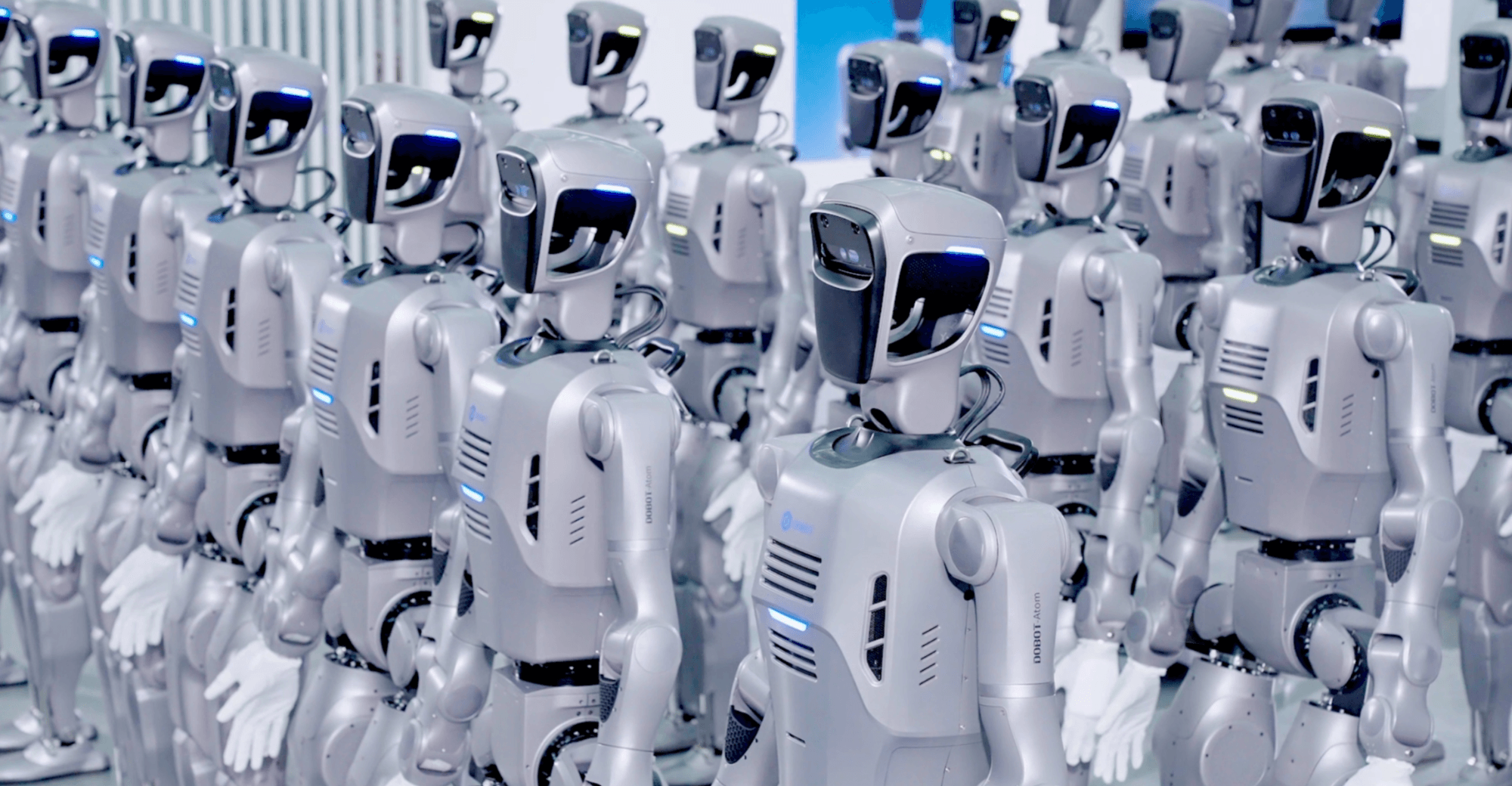
Dobot has officially launched the third batch of its full-size industrial humanoid robot, ATOM, marking the start of its planned mass production and delivery phase in 2026, with deployments rolling out across real-world industrial settings.
According to videos released by Dobot from the delivery site, rows of humanoid robots move in perfect synchronization, demonstrating stable bipedal walking, advanced dynamic balance, complex dance routines, and high-precision assembly tasks. The visual impact underscores not only Dobot’s progress toward its 2026 large-scale delivery milestone, but also signals that its humanoid robots are accelerating into a new phase of scalable, scenario-driven industrial application.
As humanoid robots worldwide transition from laboratory prototypes to commercial deployment, mass production capability has become a key litmus test of technological maturity. In this intensifying race, Dobot is among the first companies to push a third batch of full-size humanoid robots into the market, making it one of the few players to successfully close the full loop from “production” to “delivery” to “real-world application” at scale.
Notably, while many global competitors in humanoid robotics originate from research labs or niche technical domains, Dobot has taken a distinctly different path. The company describes itself as the “only embodied-intelligence enterprise born directly from the manufacturing floor.” This industrial pedigree has endowed its full-size industrial humanoid ATOM series with three core advantages rooted in real production environments: industrial-grade reliability and proven mass-manufacturing capability; deep scenario understanding with an emphasis on task completion; and seamless integration as part of an “embodied-intelligence super factory,” where humanoid robots collaborate with wheeled and multi-legged robots under a unified intelligent control hub to deliver flexible productivity solutions.
On the manufacturing side, large-scale production of full-size humanoid robots is far from simple replication on an assembly line. It represents a comprehensive test of supply-chain integration, quality control, and process engineering. Dobot’s 165-centimeter-tall ATOM reflects robust systems-engineering capabilities across the entire production pipeline. From core component selection to final assembly and calibration, every robot undergoes standardized, end-to-end process control.
Quality assurance is reinforced through a multi-layer inspection framework covering incoming component checks, real-time assembly monitoring, and full-system performance testing. Key metrics such as dynamic balance and motion precision are subject to unified, stringent standards, ensuring consistency and high reliability across all delivered units.
The full-size ATOM has also demonstrated the ability to autonomously stand up from a fully prone position, perform complex dance movements, and maintain strong dynamic stability. While seemingly simple, such actions place demanding requirements on whole-body coordination, torque distribution, and trajectory planning, highlighting the system’s integrated control capabilities.
On the intelligence front, ATOM is powered by Dobot’s self-developed DOBOT-VLA (Vision-Language-Action) model. Through end-to-end integration of visual perception, natural-language understanding, and motion generation, the model converts abstract instructions into structured task chains and outputs continuous, generalizable motion trajectories. By combining reinforcement learning with real-world scenario data alignment, the system enables robots not only to “understand instructions,” but also to autonomously adapt to changing conditions.
A practical example can be seen in the popcorn-making robot deployed at Shenzhen’s K11 cinema. Rather than executing fixed, pre-programmed routines, the robot functions as an intelligent agent capable of contextual understanding, autonomous decision-making, and error correction. This scenario-driven adaptability is widely regarded as a core requirement for humanoid robots to deliver real value in complex, real-world environments.
Dobot’s founder has previously noted that the true watershed moment in AI development is not whether systems can “sound intelligent,” but whether they can “actually get things done.” The real value of AI lies in improving production efficiency, shortening delivery cycles, reducing accident rates, and ultimately increasing human well-being through the creation of tangible economic value.
In his view, AI is not about replacing humans, but about redistributing work. Productivity gains accrue to those who can effectively leverage AI to amplify their capabilities. The purpose of embodied-intelligence humanoid robots, he argues, is to increase the availability of “good jobs” by freeing people from dangerous, monotonous, or health-damaging tasks—such as repetitive material handling, dusty environments, welding fumes, and high-intensity night shifts—that should not be long-term human burdens.
Looking ahead, China’s upcoming “15th Five-Year Plan” has already designated embodied intelligence as one of six strategic future industries. As the core physical carrier of embodied intelligence, humanoid robots are entering a critical window in which technological breakthroughs are poised to translate into large-scale industrial adoption.
As one of the few embodied-intelligence companies to emerge directly from manufacturing practice, Dobot continues to emphasize “technology rooted in real scenarios.” Through scaled delivery and on-site deployment, the company is accelerating the integration of humanoid robots into real operational environments across industrial and commercial sectors, contributing to the next chapter of China’s “AI+” transformation.
Source: IPOzaozhidao
Originally written by: Pandaily
Source: Pandaily
Published on: 4 February 2026
Link to original article: Dobot Launches Third Batch of Full-Size Industrial Humanoid Robots ATOM, Targets Mass Delivery in 2026
