
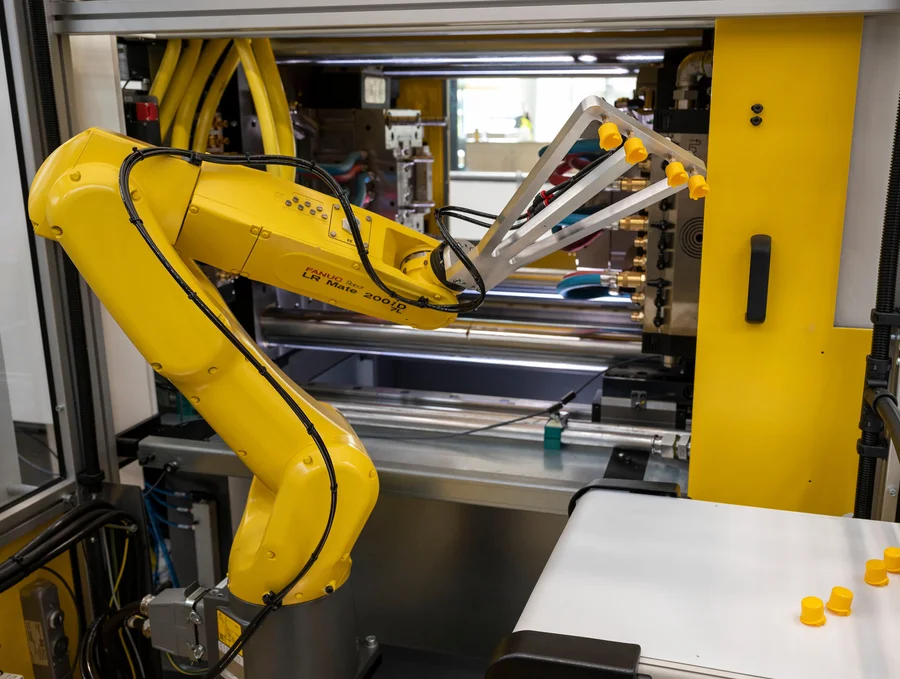
Manufacturers are scaling industrial robotics to decouple production from labour availability as China leads a massive global surge in automation adoption
Manufacturers across the globe are turning to industrial robotics as labour markets tighten and the economics of automation become increasingly favourable.
The shift could signal a fundamental recalibration of how production capacity is scaled in an era where human workforce availability can no longer be guaranteed.
According to the International Federation of Robotics, more than 542,000 industrial robots were installed during 2024. The geographic concentration of these deployments reveals a clear pattern, with three-quarters positioned across Asia, 16% throughout Europe and 9% in the Americas.
Looking ahead to 2026, both the OECD and the IMF project global growth will reach 3.1%, suggesting economic conditions that could support continued capital investment in automation technologies.
“The transition of many industries into the digital and automated age has been marked by a huge surge in demand,” explains Takayuki Ito, President of the International Federation of Robotics.

Takayuki Ito, President of the International Federation of Robotics
The technical demands of sophisticated robotics implementations require software interoperability and extensive global supply networks that typically only enterprise-scale robotics vendors can provide.
Economic drivers for automation
Labour availability has emerged as a critical constraint for manufacturers. According to Deloitte’s 2025 Smart Manufacturing Survey, 48% of manufacturers encounter moderate to significant challenges when attempting to fill production and operations positions.
Advanced robotics combined with AI-powered automation represent the principal strategies being deployed to separate production volume from workforce availability. The same survey indicates that manufacturers adopting smart manufacturing technologies report production output improvements ranging from 10% to 20%.
According to industry analysis, transferring repetitive or physically hazardous tasks to automated systems can also generate gains in existing employee productivity. Automating physical workflows and connecting them with manufacturing execution systems could unlock up to 15% additional capacity.
Industry experts note that the total cost of ownership for industrial robots continues to decline as sensor costs drop, integration protocols become standardised and robotics as a service models expand.
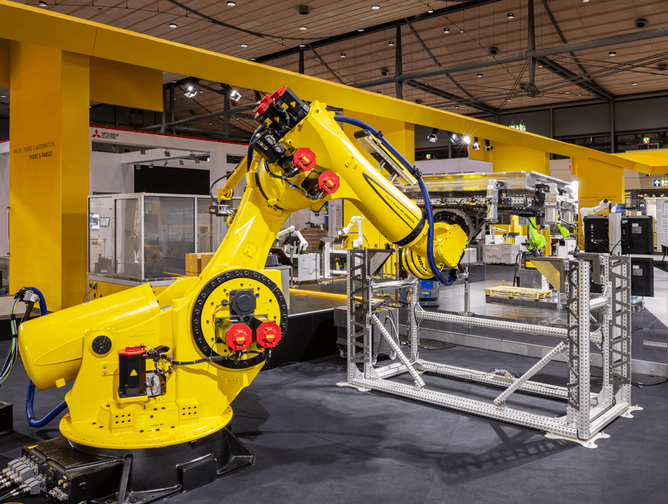
FANUC holds a massive global share of the CNC systems and industrial robotics market. Credit: FANUC
Leading robotics providers globally
FANUC originated as a special project team within Fujitsu in 1955 before establishing itself as an independent entity in 1972. Recognisable by its distinctive yellow robots, the company’s portfolio spans from high-precision collaborative robots to heavy-duty industrial configurations, giving FANUC a substantial global share of the CNC systems and industrial robotics market.
Major manufacturer ABB is divesting its Robotics division entirely to SoftBank Group, a transaction that includes industrial robots, autonomous mobile robots and AI and software platforms. The Machine Automation segment will remain with ABB and be integrated into its Process Automation business area.
UBTECH focuses on addressing labour shortages and escalating costs in manufacturing by developing robots capable of operating in human-designed environments. Its Walker S2 model can autonomously swap its own battery, reducing downtime in continuous operations.
Yaskawa Electric introduced the term Mechatronics in 1969 and has constructed its identity around the synchronisation of servos and robots. Its MOTOMAN robot brand finds application in arc welding, assembly and semiconductor wafer handling.
Teradyne owns Universal Robots and Mobile Industrial Robots, both prominent providers of collaborative robots and autonomous mobile robots. Many of its systems are engineered for low-code or no-code operation.
Regional deployment patterns emerge
China alone accounted for 54% of industrial robot deployments in 2024, with its operational robot inventory surpassing two million units. The country’s market share has also climbed to 57%, representing growth from approximately 28% over the previous decade.
Japan maintained its position as the second-largest market for industrial robots whilst Korea installed 30,600 units. India’s adoption of industrial robotics grew 7%, with the automotive industry serving as the strongest driver.
European installations fell by 8% to 85,000 units in 2024, with Germany representing the largest robot market on the continent. The UK experienced a 35% decrease in installations following the conclusion of a tax credit programme.
Robot installations in the US decreased 9%, with most units imported from Japan and Europe. Mexico and Canada similarly saw declines, with the automotive industry remaining the primary customer for robots in these countries.
Originally written by: Libby Hargreaves
Source: SupplyChain Digital
Published on: 2 March 2026
Link to original article: Is Robotics the Key to Supply Chain Stability?
