
Researchers in Korea have unveiled a breakthrough in smart materials that could transform space, robotics and deployable structures.
The Korea Advanced Institute of Science & Technology (KAIST) team developed a two-way shape memory hybrid actuator capable of rapid, reversible motion without relying on traditional motors.
Unlike conventional systems that are often heavy and mechanically complex, this lightweight material responds to external stimuli such as heat.
According to researchers, their design enables it to change shape and return to its original form in under a second, opening new possibilities for efficient, next-generation actuation technologies.
Reversible shape actuator
Shape memory materials (SMMs) are emerging as promising alternatives to conventional motor-driven systems, particularly in aerospace and robotics, where reducing weight and complexity is critical.
These materials can change shape in response to external stimuli such as heat or electricity, offering more efficient and compact actuation. However, most existing SMMs are limited by one-way, irreversible motion, making repeated use difficult and reducing their practicality in dynamic applications.
Efforts to enable reversible, two-way actuation have led to the development of systems such as semi-crystalline networks and liquid crystalline elastomers, which depend on structural alignment under applied stress. While newer stress-free approaches like interpenetrating polymer networks allow reversible motion, they often lack the mechanical strength required for demanding structural uses.
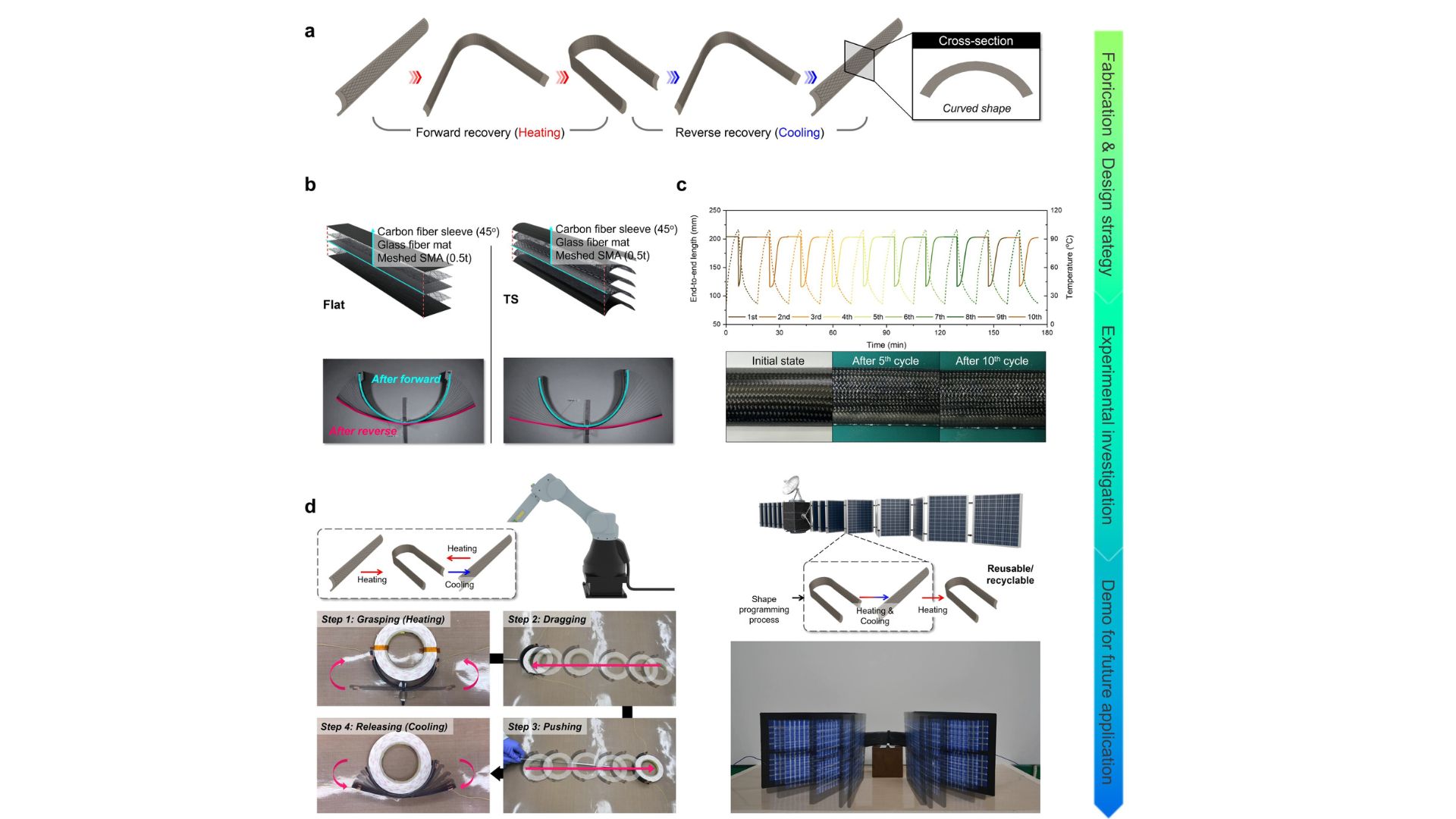
Development process of the SMA-SMP hybrid two-way actuator
To address these challenges, researchers designed a hybrid composite actuator that combines shape memory alloys (SMAs) with shape memory polymers (SMPs). SMAs provide reliable thermal recovery, while SMPs offer flexible, stimulus-responsive deformation. The team further enhanced performance by modifying the SMP’s chemical composition and reinforcing it with carbon fibers to improve stiffness and durability.
In addition, a tape spring-inspired structure was integrated into the design, enabling a “snap-through” mechanism. This allows energy stored during deformation to be released rapidly, resulting in faster actuation and improved precision. Together, these innovations enable consistent, repeatable motion, making the actuator well-suited for advanced engineering and next-generation robotic systems.
Advanced robotics material
The newly designed actuator achieves full two-way motion, bending when heated and returning to a flat state as it cools.
Researchers highlight that it delivers a significantly wider deformation range and nearly 100 percent recovery of its original shape, while operating at sub-second speeds. The actuator also demonstrated 8.6 times wider reversible deformation and a 4.9 times faster reverse recovery.
The actuator maintains consistent performance over repeated cycles without requiring complex control systems, addressing a long-standing limitation of conventional shape memory materials. This combination of speed, precision, and durability marks a significant step toward real-world applications.
The team claims the technology could be applied across various fields, including robotic grippers that require repetitive motion and deployable structures for space missions, where lightweight and reliable actuation systems are critical.
“This research overcomes the physical limitations of materials through original structural design, elevating the performance of shape memory actuators to the next level,” said Professor Seong Su Kim from the Department of Mechanical Engineering at KAIST and the research lead, in a statement to TechXplore.
The paper was published in the Advanced Functional Materials journal.
Originally written by: Jijo Malayil
Source: Interesting Engineering
Published on: 26 March 2026
Link to original article: Korea develops rapid, reversible smart actuators without motor for next-gen robots
