
For many warehouses, the loading and unloading process is one of the final areas that can tap into viable automated technology to improve operations, but that might be changing.
Historically, other automation applications, such as case pick robotics, have been more accessible to businesses than loading technologies because they have a faster return on investment, according to Michael Perry, head of commercial strategy at Persona AI and a former executive at robotics companies Dexterity and Boston Dynamics. Artificial intelligence-powered picking robots can easily adapt to changing workflows and use mobility to work across multiple warehouse locations, he added.
Meanwhile, adopting automation for loading and unloading can often be “the last piece of the puzzle” for companies, according to Perry, with many companies considering dock automation either impossible or impractical.
However, the cost of implementing loading and unloading robotics and case-picking systems can get close to parity depending on utilization, Perry said, noting that robots carry less risk for injury, theft, or damage. In some scenarios, robotics could replace lumper services typically used by smaller 3PLs, he added.
“This is a very manually intensive job, to unload these trailers in a lot of cases,” Ken Barbour, a director at consultancy BRG who specializes in retail performance and supply chain, said. “The manpower that [robotics] takes away plus the safety aspect — it might be a good spot to start.”
Loading robotics require new processes
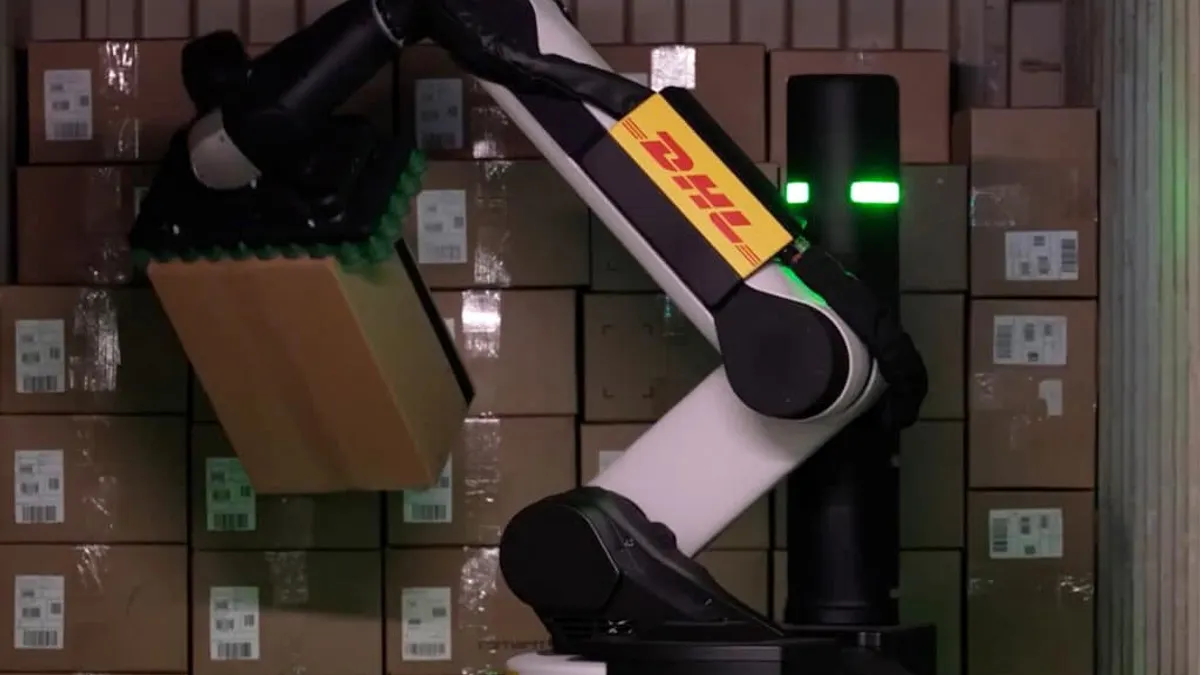
In 2021, Boston Dynamics rolled out Stretch — a material handling robot that was expected to have a pick rate of 800 cases per hour, could lift up to 50 pounds and have a battery life of eight hours. DHL brought the robot to market and has since signed on to deploy more than 1,000 Stretch robots across its global operations.
Change management is necessary for warehouses installing their first automation or robotic solutions, according to Omer Rashid, VP of operations development for automation, innovation and analytics at DHL Supply Chain.
However, retrofitting a warehouse isn’t a one-size-fits-all approach, Rashid said. For instance, while DHL has plans to unleash thousands of robots, whether through Boston Dynamics or other partnerships, unloading robots won’t be rolled out at every single warehouse location in North America.
“We consider factors such as volume, product size, shape or orientation, product weight, etc. Our unloading robots are deployed to all sites with the right operational fit,” Rashid said in an email.
Although every solution won’t automatically be a perfect fit, it’s worth it to try, according to Barbour, who encourages warehouse operators to pressure test available technology to determine its usage and benefits.
What’s next?
Despite their potential benefits, robots can be limited by the items they’re unloading, Rashid said. For instance, robots may have difficulty handling irregular loads, such as varying shapes, or excessively light or heavy products. He added that streamlining existing processes, such as standardizing inbound flows, can help handle load irregularities.
Looking ahead, advancements in visual identification and self-correction should eventually be able to address technology limitations, Rashid said. Charging and battery life, too, are set to increase, which would increase utilization. But Perry noted incremental gains won’t necessarily have a significant impact on operations.
“Will there be stronger robots? Absolutely,” Perry said. “That’s not going to change our customers’ business.”
What will breed change is data, according to Perry. Stitching together data from all areas of the warehouse and allowing machines to share information with each other can give a clearer picture of what material flows look like so companies can formulate trend lines.
For example, if the robotic system know a specific truck line is typically late, they can pause building for that order, focus on other work and wait for that truck to come in to build the rest of that order, Perry said.
Originally written by: S.L. Fuller
Source: Supply Chain Dive
Published on: 30 March 2026
Link to original article: Robotic unloading becomes more accessible as warehouses weigh applicability
