
Chinese humanoid robotics company Unitree Robotics says it may work with Korean companies on robot intelligence technologies, even as it keeps tight control over the hardware side of its machines.
The company revealed its strategy during the China Humanoid Conference held at Automation World (AW) 2026 in Seoul’s COEX on March 4. Unitree executives said the firm already designs and manufactures more than 90 percent of the hardware used in its robots, giving it strong control over cost, reliability, and production.
At the same time, the company signaled that Korea could play an important role in developing the intelligence that powers those machines.
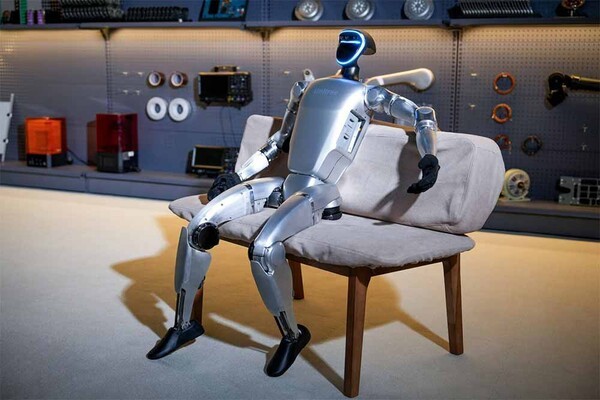
A Unitree G1 humanoid robot on display at an Electromart store operated by Emart in South Korea. Photo by Unitree Robotics
Unitree Builds Most Robot Hardware In-House
Unitree has built its robotics business around a vertically integrated manufacturing model. According to Jiang Chengyi, head of solutions at Unitree Robotics, the company designs and produces most of the core components that go into its robots.
That includes motors, joint systems, and sensors, which are among the most critical parts of a humanoid robot.
“We have a structure that allows us to design and manufacture most of the hardware ourselves,” Jiang said during a media briefing at the event.
By reducing dependence on external suppliers, Unitree aims to lower production costs while improving product reliability. The strategy also helps the company scale manufacturing as the global humanoid robot market expands.
Industry analysts say that vertical integration could become a key advantage in the race to commercialize humanoid robots.
Korea Seen as Strong Partner in Robot Intelligence
While Unitree believes its hardware capabilities are already competitive, the company sees room for collaboration in robot intelligence.
Jiang pointed to Korea’s strength in manufacturing and software development, noting that Korean companies could help train robots to understand environments and perform tasks.
“Korea has strong manufacturing and software capabilities,” he said. “We see opportunities to collaborate on technologies that teach robots how to perceive environments and execute work.”
He mentioned companies such as Hyundai Motor as examples of potential industrial partners.
Under such a model, Unitree would supply the robot hardware platform while Korean partners could develop AI systems and industry-specific solutions on top of it. The approach reflects a growing trend in robotics where hardware and intelligence are developed by different players within the ecosystem.
Developer Ecosystem Expands Through Robot Platform
To accelerate innovation, Unitree is also opening up its robotics ecosystem to developers.
The company operates a mobile platform called Unitree Explore, an app where developers can create and share motion libraries for the humanoid robot G1.
Developers can upload motion codes and behaviors that other users can download and apply to their own robots. The platform is designed to encourage experimentation and speed up application development.
Unitree has also introduced a technology called VLA-0, a model trained on visual, language, and action data.
The system acts as a foundation model for robotics, allowing robots to interpret surroundings and generate appropriate actions. It has been trained on hundreds of hours of robot operation data to build basic movement and interaction capabilities.
The company hopes these tools will help developers build new services on top of Unitree hardware.
Interest in the G1 Humanoid Robot Is Growing in Korea
Unitree said demand for its humanoid robot G1 is increasing in Korea, especially among research institutions and robotics developers.
The robot is currently sold through official distributors in Korea, and it is also available at Electromart, the electronics retail chain operated by Emart.
G1 is priced at about 13,500 dollars, roughly 20 million Korean won. The relatively low price has made it attractive as a research and development platform for robotics engineers.
“Our goal is to bring the G1 to developers and companies across Korea and global markets,” Jiang said.
The company is also developing a larger humanoid robot called H2. Unlike the G1, which focuses on research and experimentation, H2 is designed for industrial environments such as manufacturing and logistics.
Global Humanoid Robot Competition Is Accelerating
The global race to develop humanoid robots is intensifying.
Major U.S. players including Tesla, Figure AI, and Agility Robotics are pushing forward with new designs and pilot programs. Chinese robotics companies are also moving quickly to release products and scale production.
Unitree is betting that its vertically integrated hardware strategy and competitive pricing will help it expand globally.
Its openness to collaboration with Korean companies could also create new opportunities for Korea’s robotics industry, especially in areas like AI software, industrial robotics applications, and smart manufacturing.
As the humanoid robot ecosystem takes shape, partnerships between hardware makers and AI developers may become one of the defining trends of the next robotics wave.
Originally written by: Tech Insider Columnist
Source: KMJournal
Published on: 5 March 2026
Link to original article: Unitree Eyes Korea for Robot AI Partnerships as Humanoid Race Heats Up
