
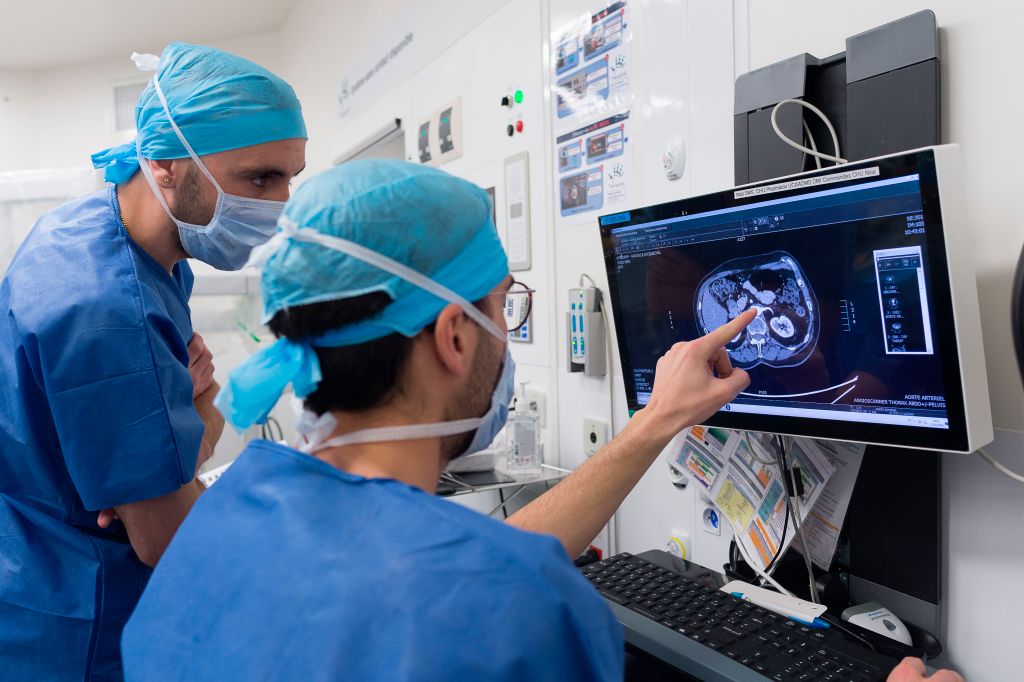
Brussels wants to expand its European network of AI‑powered medical screening centres, seeking to overcome long‑standing challenges around data quality and detect cancer at very early stages.
The Commission has already built a network of 270 advanced screening centres spanning hospitals and care facilities across the bloc under the Apply AI Strategy presented last October.
In these centres, pre-symptomatic abnormalities can be detected through analysis of imaging data, including MRI, CT, X‑ray, PET and ultrasound. Therefore, early detection and diagnosis of cancer and cardiovascular diseases could prove to be decisive for patients’ lives.
Industry players are already moving in this direction.
“AI screening can help diagnose lung or prostate cancer at early stages. Cancer detection rates increase by 20–30% when AI is used, which has a tremendous effect,” Siemens Healthineers’ director of innovation, David Labajo, told Euractiv.
While the survival rate for stage‑1 lung cancer exceeds 85%, it drops to just 6% at stage 4. “If we don’t use AI to support early diagnosis, we’re stealing that opportunity from patients”, Labajo added.
A new call to fund large-scale pilots deploying AI in real-world clinical imaging will add two more hospitals to the network. The goal is to train AI systems on two priority disease areas – cancer and cardiovasular diseases – while generating new European patient datasets to improve performance and accuracy of AI tools.
“In terms of disease areas or medical use cases, the focus here is really on cancer and cardiovascular diseases,” said Matthieu Ruthven, programme officer for Digital Health Technologies at the European Commission. He confirmed to Euractiv that the Commission’s European Beating Cancer Plan and the Safe Hearts initiative are “one of the reasons” driving this strategic focus for the two new funding projects.
The data trap
But effective diagnosis depends on the quality of the data used to train these systems.
“The goal is to implement an AI system running European AI algorithms developed, trained and validated using very large sets of patient data,” Ruthven said.
This is crucial, as Europe continues to face a major bottleneck: limited access to representative datasets.
“The reality is that most of the AI tools we have in the EU today are trained on non‑European data,” warned Fulvia Raffaelli, head of the Digital Health Unit at DG SANTE, during Euractiv’s Health Policy Conference.
She called this a risk to accuracy and reliability. Raffaelli pointed to AI skin‑cancer diagnostic tools trained on Asian populations, which show higher error rates when applied to European patients.
EU Commission President Ursula von der Leyen, herself a trained medical doctor, has promised that advanced screening centres will lead to “top-class healthcare in all corners of Europe, with shorter waiting times”.
(sm, cm)
Originally written by: Magdalena Kensy
Image credit: Universal Images Group /Getty Images
Source: Euractive
Published on: 22 May 20256
Link to original article: EU boosts AI to tackle cancer early, but data remains an issue
