

On the 19th (local time), at Google’s annual conference ‘I/O 2026’ held at the Shoreline Amphitheatre in Mountain View, California, U.S. A person wearing AI glasses (glasses) stood in front of a bookshelf filled with various cookbooks and said, “I’m going to cook for vegetarians. Please find the most suitable book.” A whisper-like voice from the glasses responded, “I recommend the vegetable cookbook at the far right.” After taking out the cookbook and viewing a pasta recipe, the person requested, “Please add the necessary cooking ingredients to the shopping list.” The required ingredients, including spinach, were automatically added to Google’s shopping AI feature, ‘Universal Cart,’ on the smartphone. Without typing text or accessing external apps or webpages, the person completed finding a recipe and shopping for ingredients simply by wearing the glasses and conversing with them.
Google unveiled AI glasses with significantly enhanced AI capabilities at the event. The official name is ‘Intelligent Eyewear.’ Developed in collaboration with Samsung Electronics, Qualcomm, and designed by Korean eyewear brand Gentle Monster and U.S.-based Warby Parker, the glasses are part of Google’s push to compete in the next-generation AI device market.
◇Google and Samsung Develop ‘AI Glasses’
Google previously released smart glasses in 2012. Though initially praised as an innovative wearable device, they faced backlash over privacy concerns due to their camera recording all visible surroundings, short battery life, and were eventually discontinued for consumer sales in 2015. However, as the need for new form factors specialized in AI functions emerged, Google announced at last year’s ‘I/O’ that it would collaborate with Samsung Electronics and Qualcomm to develop AI-powered glasses.
Samsung Electronics built the ‘Android XR’ platform with Google and Qualcomm and handled hardware components like the battery, microphone, and speaker. Samir Samat, Google’s Android ecosystem division president, said, “Since this is a device worn all day, millimeter-level precision in weight, battery life, and comfort is required, so we combined Samsung’s excellent hardware design technology to enhance completeness. We highly value our collaboration with Samsung.”
The prototype AI glasses unveiled featured temple parts slightly thicker than aluminum glasses, with a power button, touchpad for app operation and volume control, and a button to turn the display on and off. Users could operate the glasses by swiping or tapping the touchpad with one or two fingers.
During a 10-minute trial, the reporter hardly needed to use their hands. For instance, while looking at a concert poster on the wall and requesting, “Please play the music from this concert,” the YouTube app on the smartphone automatically launched, and the song played through the glasses. When a conversation partner greeted in Korean, “Hello,” real-time English translation was also available.
The AI glasses are equipped with Google’s AI model Gemini, which excels at understanding voice, image, video, and text. This makes it suitable for interpreting objects in the user’s field of view or documents in real time. For example, when the reporter said in front of a mirror, “Take a photo of me and make it look like a soccer player,” the glasses automatically took a photo and used Google’s image generation and editing feature, ‘Nano Banana,’ to create a soccer player image. Another competitive edge is the seamless integration of Google apps like Google Maps and Google Calendar with the glasses and the Gemini AI model.
However, compared to Meta’s first AI glasses, ‘Meta Ray-Ban Display,’ released last year, the Google glasses had clear drawbacks. Unlike Google, Meta uses a wristband to operate its AI glasses. Users can operate functions by moving their hands in the air while wearing the band, eliminating the need to touch the temple. Meta’s transparent display, which overlays the real world, was also cleaner and more comfortable for the eyes. While Meta began selling display-equipped AI glasses last year, Google’s AI glasses are expected to launch only next year.
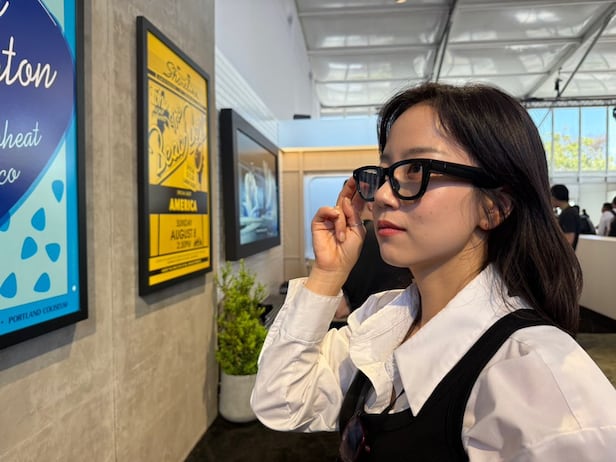
On the 19th, local time, in the afternoon, correspondent Kang Da-eun experiences Google’s AI glasses at the annual conference ‘I/O’ held in Mountain View, California, U.S. The glasses can be operated by pressing or rubbing the right temple with a finger. /Courtesy of Kang Da-eun
◇“Design as Important as Technology”
Google emphasized that design is as crucial as functionality for AI glasses, as they are devices people wear daily and must be comfortable and aesthetically pleasing. This is why Google is collaborating with Gentle Monster and Warby Parker, brands popular among global MZ generations for their unique designs and sensory store displays. However, the prototypes unveiled at the I/O event were not the final designs to be sold by Gentle Monster and Warby Parker.
Samat said, “We learned the important lesson from the past Google Glass failure that ‘design should come before technology.’ Only if the glasses are stylish and comfortable enough for users to want to wear them can the benefits of the technology be delivered.”
Originally written by: Kang Da-eun
Source: The Chosun Daily
Published on: 20 May 2026
Link to original article: Google’s Hands-Free ‘Intelligent Eyewear’ Developed with Samsung
