
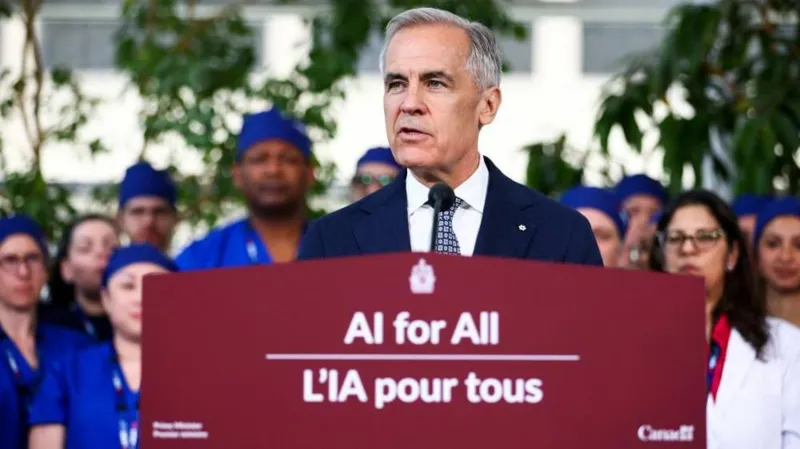
Canada’s government has released a much-anticipated national artificial intelligence (AI) strategy, mapping out how the country plans to adopt the new technology over the next decade.
It comes amid broader public concerns over trust of AI and its impact on privacy, safety and future job security.
Announcing the strategy on Thursday, Prime Minister Mark Carney said the arrival of AI is inevitable. “It is already changing how we work, how we learn, and how we connect,” he said.
It includes more than C$2bn ($1.4bn; £1bn) in spending for programmes to increase AI literacy and scale up its use by businesses and government.
It also puts emphasis on keeping AI talent in Canada, acknowledging an “uncomfortable reality” that the US has been a more attractive place to set up shop for Canadian AI pioneers.
Here are some key takeaways on what is included – and what isn’t – in Canada’s AI strategy.
Canadian sovereignty through AI
Sovereignty has been top of mind for Canada ever since US President Donald Trump began referring to it as the “51st state”, and its AI strategy is no different.
It names protecting Canada’s sovereignty as a key objective and underlines ways that the country can reduce its reliance on “foreign providers” for its AI needs.
The strategy notes that Canadian companies store sensitive data in foreign jurisdictions, and that, in some cases, Ottawa is relying on infrastructure that Canada does not own.
In announcing the strategy, Carney warned that “AI could be weaponised against us”.
Ottawa is proposing building what it calls a “world-leading” public supercomputer that would be secure and accessible for Canadian researchers and businesses.
It also wants to support the building of “large-scale AI data centres” to serve Canadian clients, with a goal of significantly enhancing computing capacity by 2030.
Stopping the AI brain drain
Canada is known for its highly educated population, but its close proximity to the massive US economy has meant it has struggled to retain its talent, particular in the AI sector.
Geoffrey Hinton, the Canadian researcher and Nobel Prize winner nicknamed the “Godfather of AI”, sold his company to US tech giant Google and had worked for the tech firm for years.
Originally written by: Nadine Yousif
Image credit: Reuters
Source: BBC
Published on: 4 June 2026
Link to original article: What to know about Canada’s new AI strategy
