
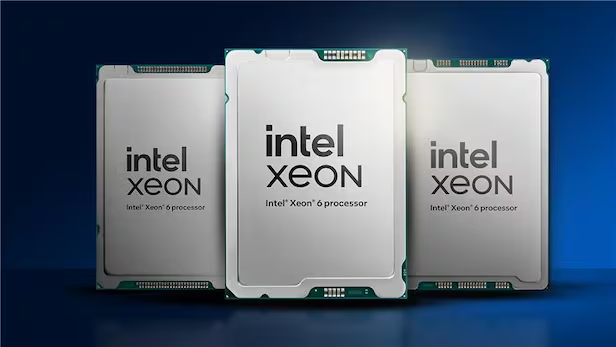
In the era of artificial intelligence (AI), central processing units (CPUs), which had fallen out of favor behind graphics processing units (GPUs), are once again gaining attention. As AI agents (secretaries) become more prevalent and AI advances to stages requiring the processing of multiple tasks, the importance of CPUs—serving as the “control tower” of AI data centers—has grown significantly. The market is experiencing a shortage of data center CPUs, leading to soaring prices. Analysts suggest that infrastructure bottlenecks in the AI era, previously centered on GPUs and memory, are now expanding to include CPUs.
◇The Resurgence of the Longtime Powerhouse, CPUs
Intel and AMD, which dominate the global CPU market, raised CPU prices by 15% this year. According to Nikkei Asia, the average delivery time for CPUs has also increased from 1–2 weeks to 8–12 weeks, reflecting worsening supply shortages. Semiconductor industry sources revealed that AI cloud providers like Amazon are aggressively expanding CPU servers but still face severe shortages. Global investment bank KeyBanc noted, “Intel and AMD have already sold most of their server CPU production capacity for this year,” adding, “This strong demand could persist until 2027.” Intel and AMD’s stock prices have risen 74% and 25%, respectively, compared to the start of the year.
CPUs are core semiconductors specialized in handling complex computations. They have long been considered the most critical chips in computing systems, acting as the “brain” in PCs, data centers, and other devices. However, with the rise of AI, GPUs—better suited for parallel processing of simple computations—became essential for AI training and operations, relegating CPUs to a supporting role. In fact, AI data centers typically had a structure with 4–8 GPUs per CPU. As AI demand surged, the need for “soldier” GPUs outpaced that for “commander” CPUs.

Graphics by Baek Hyeong-seon
The emergence of AI agents has changed this dynamic. While existing large language models (LLMs) were relatively simple, providing answers when asked questions, AI agents must perform more complex tasks, such as planning operations and calling external tools. This has driven explosive demand for CPUs, the “orchestrators” of these tasks. Market research firm TrendForce stated, “While existing AI data centers required 30 million CPU cores (processing units) per gigawatt (GW), the AI agent era will demand 120 million cores,” adding, “The CPU-to-GPU ratio will shift to 1:1 or 1:2.”
◇Shifts in the Memory Landscape
Amid this trend, semiconductor companies are increasingly developing their own CPUs. NVIDIA, the GPU market leader, expanded its Grace, Vera, and other CPUs as standalone products in February. Arm, a British semiconductor design intellectual property (IP) company, launched its first data center-specific CPU, the “Arm AGI CPU,” last month—its first in 35 years.
As demand surges for both GPUs and CPUs, domestic memory companies, once seen as major beneficiaries of the AI era, are poised for even greater opportunities. Samsung Electronics and SK Hynix are achieving record-high performances due to soaring sales of high-bandwidth memory (HBM) for GPU-based AI chips. Analysts suggest that demand for high-performance general-purpose DRAM (DDR5) used in CPUs could also rise long-term. While DDR5 is already reported to have surpassed HBM in profitability due to severe supply shortages, additional demand could further boost sales. A source from the semiconductor industry remarked, “The CPU shortage and price hikes for data center construction demonstrate that companies’ server investments remain aggressive,” adding, “As the adoption of the latest CPUs increases, demand for high-performance memory will also surge, positively impacting the sales growth of domestic memory firms.”
Originally written by: Park Ji-min
Source: The Chosun Daily
Published on: 20 April 2026
Link to original article: CPUs Resurge in AI Agent Era Amid Shortages
